Learn how NLP works using Python’s NLTK library, understand sequence analysis, and explore real-life applications of NLP like chatbots and sentiment analysis.
Imagine this…
You pick up your phone and say, “Hey Siri, play my workout playlist.” Within seconds, music fills the room. You didn’t press a button or type a command — you simply spoke.
That magical moment of your device understanding your words is powered by Natural Language Processing, or NLP — the art and science of teaching computers to comprehend human language.
🌍 What Is Natural Language Processing?
Language is humanity’s most powerful invention — it carries thought, emotion, and culture. But for a computer, language is chaos: irregular, emotional, and full of exceptions. That’s where NLP, a branch of Artificial Intelligence (AI), comes in.
At its core, NLP bridges human communication and machine understanding.
It enables machines to read, interpret, and respond to language in a way that feels natural.
Think of it like this:
Humans communicate in meaning and context, while machines think in logic and data. NLP is the translator between these two worlds.
In essence, NLP allows computers to:
- Listen – Convert spoken words into digital signals and recognize them.
- Read – Process written text from documents, chats, or web pages.
- Think – Understand intent, emotion, and grammatical structure.
- Reply – Generate meaningful, context-aware responses.
When you say, “What’s the time?”, your voice becomes text, your text becomes data, and the system instantly returns the correct answer — all thanks to NLP.
💡 Why NLP Matters More Than Ever
We live in a world overflowing with words — billions of messages, posts, reviews, and comments shared daily. Somewhere within this chaos lie opinions, needs, and insights waiting to be understood. NLP makes sense of it all.
Everyday applications of NLP:
- 🎙️ Voice Assistants: Siri, Alexa, and Google Assistant rely on NLP to interpret and respond to speech.
- 🌐 Translation Tools: Google Translate breaks down language barriers instantly.
- 💬 Chatbots: Customer service bots understand and respond to your queries 24/7.
- 📊 Sentiment Analysis: Businesses gauge public mood from tweets or reviews.
- 📧 Email Filtering: NLP separates spam from your inbox.
- 🔍 Search Engines: Google understands what you mean, not just what you type.
In essence, NLP powers the language of the digital world. It helps businesses, platforms, and technologies understand people — one word at a time.
🐍 Getting Started with NLTK — Your First Step into NLP
If you’re just beginning your journey in Natural Language Processing, there’s one tool you’ll hear about over and over again — NLTK, or the Natural Language Toolkit.
What is NLTK?
NLTK is a powerful open-source Python library designed for linguistic analysis and text processing.
It allows you to explore everything from word tokenization and part-of-speech tagging to sentiment detection and grammar parsing — all in a few simple steps.
But NLTK isn’t just a library — it’s a learning playground.
It lets beginners experiment with real-world text data and understand how machines interpret human language.
With NLTK, you don’t need to be a data scientist to explore NLP. You just need curiosity — and a few lines of Python to start analyzing how language behaves.
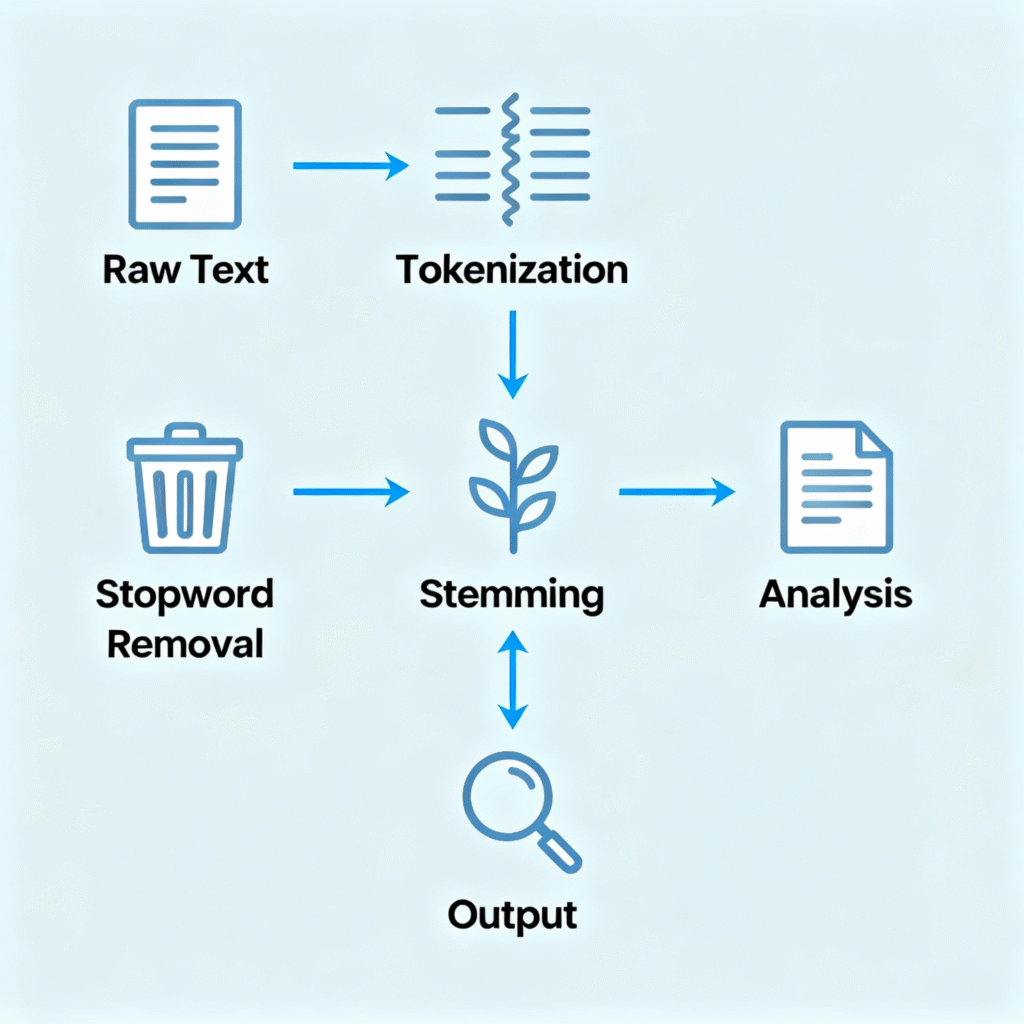
✂️ The Foundation: Text Preprocessing
Before machines can understand text, they must clean and structure it. Raw text is messy — full of punctuation, capitalization, filler words, and variations.
Preprocessing is like teaching the computer to “see clearly.”
1. Tokenization
Tokenization means breaking text into smaller parts — called tokens.
For instance:
“Natural Language Processing is fun.” → [Natural, Language, Processing, is, fun]
Each token becomes a unit for analysis.
2. Stopwords Removal
Stopwords are common words like “the”, “is”, “in”, or “on” — they don’t add much meaning.
Removing them helps the system focus on what matters: the content words.
Example:
“The cat is on the mat.” → [cat, mat]
3. Stemming
Stemming reduces words to their root form by chopping off suffixes.
“Running”, “runs”, and “ran” all become “run.”
It simplifies text and treats similar words as one.
4. Lemmatization
Lemmatization is smarter — it uses context and grammar.
“Better” → “Good”, “Studies” → “Study”.
It’s how NLP keeps meaning intact while standardizing text.
These preprocessing steps lay the groundwork for deeper analysis — where machines start recognizing patterns, sequences, and meaning.
🔄 Understanding Sequence Analysis in NLP
Once text is cleaned, we move to Sequence Analysis — the heart of language understanding.
Language isn’t just about words; it’s about order.
Consider:
- “Dog bites man.”
- “Man bites dog.”
Same words. Different story.
Sequence analysis helps computers see that difference.
So, what exactly is Sequence Analysis?
Sequence Analysis in NLP studies the order, pattern, and dependency between words.
It helps systems understand grammar, relationships, and meaning in context — not just in isolation.
Without it, machines would only count words. With it, they begin to understand sentences.
⚙️ Core Techniques of Sequence Analysis
Let’s explore the building blocks that help machines analyze language order and structure.
1. N-Grams: Understanding Word Patterns
An N-Gram is a sequence of n consecutive words.
It captures how words naturally co-occur in text.
Example (from “I love NLP”):
- Unigrams: I, love, NLP
- Bigrams: I love, love NLP
- Trigrams: I love NLP
N-grams reveal context — like predicting the next word in a sentence.
It’s how predictive text on your phone knows what you’re about to type.
2. Part-of-Speech (POS) Tagging
Every word plays a grammatical role — noun, verb, adjective, etc.
POS tagging labels each word with its role in the sentence.
Example:
“Python is amazing.” → Python (Noun), is (Verb), amazing (Adjective)
Why is this important?
Because understanding grammar helps NLP systems know who did what.
It forms the basis for parsing and question answering.
3. Parsing: Building Sentence Trees
Parsing is about constructing the grammatical structure of a sentence.
It identifies relationships like subject, verb, and object.
For example:
- Subject: “The cat”
- Verb: “sat”
- Object: “on the mat”
Parsing is crucial in translation, summarization, and even humor detection — because meaning lives in structure.
🧭 Why Sequence Analysis Matters
Sequence analysis adds depth to NLP understanding.
It helps machines:
- Grasp grammar and sentence flow.
- Detect relationships between words.
- Capture contextual meaning instead of isolated terms.
- Understand tone and intention in conversation.
For instance, a customer saying “Your service was great!” is positive,
while “Your service was great… not!” changes tone completely — the sequence changes everything.
Without sequence awareness, machines would mistake sarcasm for praise.
🌟 Real-Life Examples of NLP at Work
NLP is woven into your daily life — often without you even noticing.
Let’s explore how it powers the systems you use every day.
1. 🤖 Chatbots and Virtual Assistants
Every time you talk to Siri, Alexa, or Google Assistant, NLP runs behind the scenes.
Here’s the magic in action:
- Speech Recognition – Your voice becomes text.
- Natural Language Understanding (NLU) – The system decodes your intent.
- Information Retrieval – It finds the relevant answer.
- Natural Language Generation (NLG) – It responds like a human.
Example:
You: “Find Italian restaurants nearby.”
Assistant: “Here are some Italian restaurants close to you.”
That’s NLP transforming data into conversation.
2. 😊 Sentiment Analysis: Understanding Emotions
Every opinion online — from tweets to reviews — carries emotion.
Sentiment Analysis helps systems read the mood behind words.
Examples:
- “I love this phone!” → Positive
- “The battery dies too fast.” → Negative
Companies use it to:
- Monitor brand reputation
- Gauge customer satisfaction
- Predict market trends
Platforms like Twitter, Amazon, and Facebook rely on NLP models to measure the public pulse — in real time.
3. 📧 Spam Detection & Email Filtering
How does Gmail know which emails are spam?
NLP models analyze subject lines, phrases, and patterns.
If an email contains sequences like “Congratulations, you’ve won!”, it’s flagged as potential spam.
Over time, the system learns from what users mark as spam or not — constantly improving accuracy.
4. 🌐 Machine Translation
When Google Translate converts “Aap kaise ho?” to “How are you?”, NLP handles more than just word substitution — it understands meaning, grammar, and culture.
Modern translation models use sequence-to-sequence learning, allowing accurate context-based translations across languages.
5. 🎤 Speech Recognition
From YouTube subtitles to voice typing, NLP converts speech into text with incredible precision.
It works in three stages:
- Capturing speech as audio signals.
- Converting audio waves to phonetic units.
- Mapping phonetics to text using language models.
Despite challenges like accents or background noise, NLP has made speech recognition faster and more accurate than ever.
6. 🛍️ Advertisement & Recommendation Systems
Have you ever noticed how your ads seem to know what you like?
That’s NLP analyzing your search patterns and keywords.
By interpreting your digital behavior — from queries to reviews — NLP helps systems recommend:
- Songs on Spotify
- Movies on Netflix
- Products on Amazon
It personalizes your online experience using language understanding.
⚠️ The Challenge: Human Language is Ambiguous
Despite its brilliance, NLP faces one big challenge — ambiguity.
Human language is layered with humor, context, and double meanings that machines find hard to decode.
The Four Types of Ambiguity:
- Lexical Ambiguity – A word has multiple meanings.
Example: “The tank was full of water.” (Water tank or army tank?) - Syntactic Ambiguity – Sentence structure causes confusion.
Example: “Old men and women were taken to the shelter.” (Are both old?) - Semantic Ambiguity – Meaning itself is unclear.
Example: “The car hit the pole while it was moving.” (Which was moving?) - Pragmatic Ambiguity – Meaning changes with context.
Example: “The police are coming.” (Good or bad news?)
Machines don’t understand tone or sarcasm — yet. That’s why NLP researchers are working on models that understand emotion, context, and world knowledge.
🧩 The Twin Powers: NLU & NLG
To make conversation feel human, NLP depends on two critical components:
1. NLU – Natural Language Understanding
This is where the machine interprets your message.
It involves tokenization, parsing, part-of-speech tagging, and intent recognition.
2. NLG – Natural Language Generation
This is where the machine speaks back.
It constructs grammatically correct, meaningful, and context-aware responses.
Together, NLU and NLG form the core of systems like chatbots and voice assistants — making conversations feel effortless and real.
🚀 The Future Speaks NLP
Natural Language Processing isn’t just a field of AI — it’s the language of the future.
It’s transforming how humans interact with machines, making technology more empathetic, intelligent, and human-like.
With tools like NLTK, anyone can start exploring this world — from cleaning text data to analyzing language sequences and meaning. It’s not just coding; it’s teaching machines to understand us.
The next generation of NLP — powered by deep learning and transformer models like GPT — will bring even more natural conversations, emotional intelligence, and cultural awareness.
🌈 Final Thoughts
Language is what makes us human.
And as NLP evolves, it brings that humanity into technology — enabling machines not just to compute, but to communicate.
From chatbots that empathize to translators that bridge cultures, NLP is changing how the world connects.
Learning it with NLTK isn’t just about coding — it’s about shaping the way we speak to the future.
Because in tomorrow’s world, the most powerful language won’t be English or Hindi — it’ll be NLP.
Next Step – Explore Services with Craze Neurons
When we look at the path to growing our skills, career, or business, we find that it is not only about time or effort but about the ways in which we use guidance, tools, and experience. At Craze Neurons, we offer a set of services that can act as a lens into knowledge, performance, and opportunity. Through these offerings, we can see the depth of learning and the perspective that comes from practical engagement.
- Upskilling Training – We provide hands-on training in Data Science, Python, AI, and related fields. This is a way for us to look at learning from both practical and conceptual perspectives.
👉 Click here to know more: https://wa.me/918368195998?text=I%20want%20to%20Upskill%20with%20Craze%20Neurons - ATS-Friendly Resume – Our team can craft resumes that are optimized for Applicant Tracking Systems (ATS), highlighting skills, experiences, and achievements. This service is available at ₹599, providing a tangible way for us to make first impressions count.
👉 Click here to know more: https://wa.me/918368195998?text=I%20want%20an%20ATS-Friendly%20Resume%20from%20Craze%20Neurons - Web Development – We build responsive, SEO-friendly websites that can be a framework for growth. It is a way for us to put ideas into structure, visibility, and functionality.
👉 Click here to know more: https://wa.me/918368195998?text=I%20want%20a%20Website%20from%20Craze%20Neurons - Android Projects – These are real-time projects designed with the latest tech stack, allowing us to learn by doing. Guided mentorship gives us a chance to look at development from a practical lens and to understand the why behind each decision.
👉 Click here to know more: https://wa.me/918368195998?text=I%20want%20an%20Android%20Project%20with%20Guidance - Digital Marketing – We provide campaigns in SEO, social media, content, and email marketing, which can be used to see our brand’s reach and engagement from a deeper perspective.
👉 Click here to know more: https://wa.me/918368195998?text=I%20want%20Digital%20Marketing%20Support - Research Writing – We deliver plagiarism-free thesis, reports, and papers, which can help us explore knowledge, present ideas, and communicate insight with clarity.
👉 Click here to know more: https://wa.me/918368195998?text=I%20want%20Research%20Writing%20Support
In all these services, we can see that learning, building, promoting, or publishing is not just a task but a process of discovery. It is a way for us to understand, measure, and reflect on what is possible when guidance meets effort.
❓ Frequently Asked Questions (FAQs) – Craze Neurons Services
1. What is included in the Upskilling Training?
We provide hands-on training in Data Science, Python, AI, and allied fields. This allows us to work with concepts and projects, see practical applications, and explore the deeper understanding of each topic.
2. How does the ATS-Friendly Resume service work?
Our team crafts ATS-optimized resumes that highlight skills, experience, and achievements. This is a service priced at ₹599 and acts as a lens to make the first impression clear, measurable, and effective.
3. What kind of websites can Craze Neurons build?
We build responsive and SEO-friendly websites for businesses, personal portfolios, and e-commerce platforms. This enables us to translate ideas into structure, visibility, and functional design.
4. What are the Android Projects about?
We offer real-time Android projects with guided mentorship. This gives us an opportunity to learn by doing, understand development from multiple angles, and apply knowledge in a controlled, real-world context.
5. What does Digital Marketing service include?
Our service covers SEO, social media campaigns, content marketing, and email strategy, allowing us to look at brand growth quantitatively and qualitatively, understanding what works and why.
6. What type of Research Writing do you provide?
We provide plagiarism-free academic and professional content, including thesis, reports, and papers. This allows us to express ideas, support arguments, and explore knowledge with depth and precision.
7. How can I get started with Craze Neurons services?
We can begin by clicking the WhatsApp link for the service we are interested in. This lets us communicate directly with the team and explore the steps together.
8. Can I use multiple services together?
Yes, we can combine training, resume, web, Android, digital marketing, and research services. This allows us to see synergies, plan strategically, and use resources effectively.
9. Is the training suitable for beginners?
Absolutely. The courses are designed for learners at all levels. They allow us to progress step by step, integrate projects, and build confidence alongside skills.
10. How long does it take to complete a service or course?
Duration depends on the service. Training programs vary by course length. Projects may take a few weeks, while resume, website, or research work can often be completed within a few days. This helps us plan, manage, and achieve outcomes efficiently.
Stay Connected with Us
🌐 Website: www.crazeneurons.com
📢 Telegram: https://t.me/cenjob
📸 Instagram: https://www.instagram.com/crazeneurons
💼 LinkedIn: https://www.linkedin.com/company/crazeneurons
▶️ YouTube:https://www.youtube.com/@CrazeNeurons
📲 WhatsApp: +91 83681 95998