Learn text preprocessing techniques in NLP, including emoji handling, normalization, and cleaning text for better machine learning results.
🧠 Introduction – Why Text Preprocessing Matters in NLP
Every day, billions of words, emojis, and hashtags flood our digital universe — from tweets and comments to chat messages and product reviews. Beneath this endless stream of communication lies a hidden treasure of insights about human emotion, opinion, and behaviour.
But before a machine can understand what all of this means, it must first understand what it is. That’s where text preprocessing comes in — the foundational step in any Natural Language Processing (NLP) project.
Text preprocessing is the process of cleaning, transforming, and standardizing raw text so machines can make sense of it.
Think of it as teaching a computer how to read properly before asking it to comprehend or analyse.
Why is this so important? Because real-world data is messy. It’s full of typos, abbreviations, emojis, punctuation marks, URLs, and mixed languages. A single tweet might look like this:
“Omg 🤯 that movie was sooo goood!!! ❤️🔥 #mustwatch”
Humans instantly get the tone — excitement, positivity, emphasis.
Machines? They see a jumble of characters and symbols.
Without preprocessing, the NLP model may misinterpret or entirely ignore valuable context — especially emotional cues hidden inside emojis or informal text.
💬 Why Emojis Are a Challenge in NLP
Emojis are the new universal language.
They transcend culture and geography — a simple “❤️” can express love, support, or appreciation in any language.
In fact, according to the Unicode Consortium, over 3,600+ emojis exist today, and billions are sent daily across platforms like WhatsApp, Twitter, and Instagram.
But while humans effortlessly understand emoji meanings, machines struggle.
Why? Because emojis add context, emotion, and nuance — the very things computers find hard to quantify.
🌀 How Emojis Affect Meaning and Sentiment
Consider the following three statements:
- “I got the job.”
- “I got the job 😭”
- “I got the job 😭❤️🔥”
Each carries a different tone:
- The first is neutral.
- The second (crying emoji) could mean tears of joy or sadness — depending on context.
- The third expresses overwhelming happiness and excitement.
To a human reader, that’s obvious. To an algorithm, it’s ambiguous.
In sentiment analysis or emotion detection, emojis can flip the meaning of an entire sentence.
A sarcastic “Great job 😂” may carry a negative tone, not a positive one.
Hence, handling emojis correctly is crucial — removing them blindly could lose meaning, while keeping them without understanding could confuse the model.
🤔 Handling Emojis – The Art of Balancing Meaning and Cleanliness
In NLP preprocessing, handling emojis isn’t about deleting cute symbols — it’s about deciding what they represent and how they influence meaning.
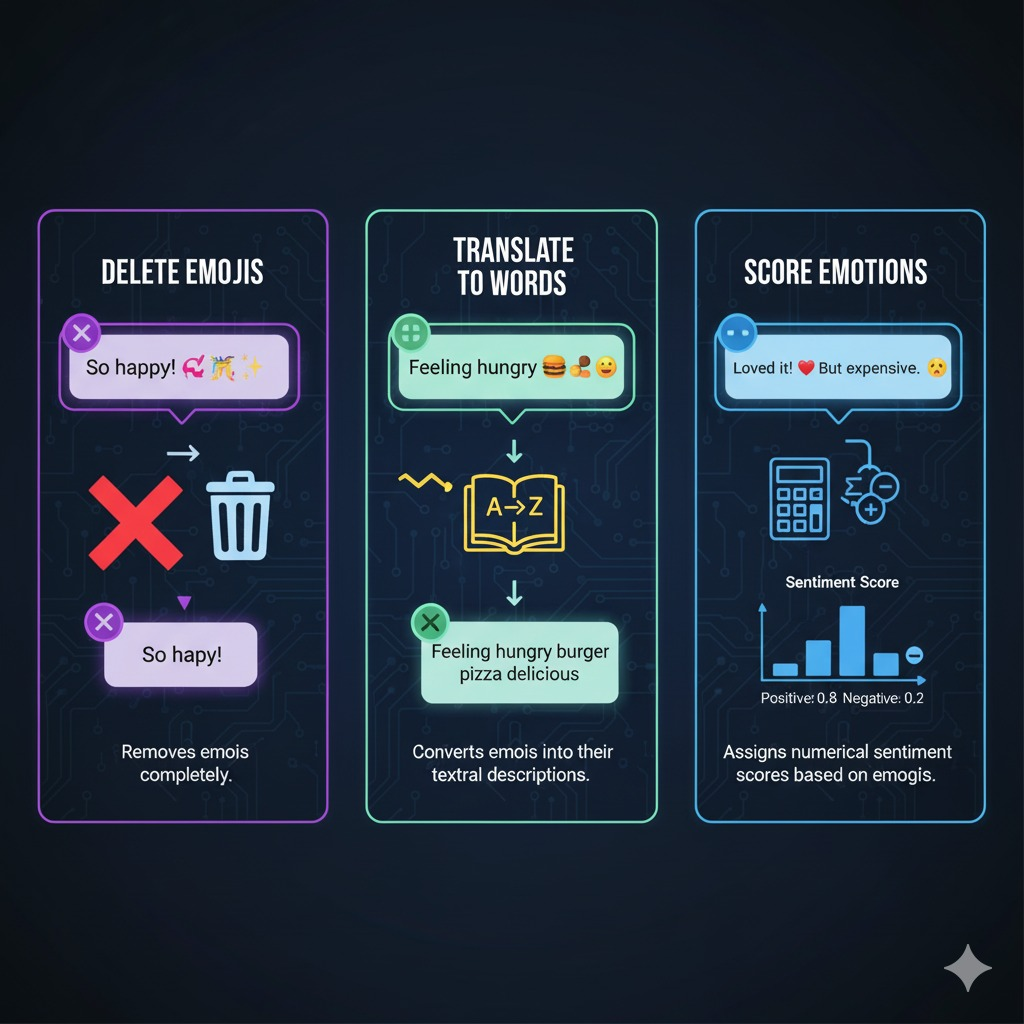
There are typically three strategies for handling emojis during text preprocessing:
1. Removing Emojis Entirely
This is the simplest approach — strip all emoji characters from text to focus purely on words.
It’s useful when:
- Emojis don’t add much meaning (like in technical documents).
- The goal is grammatical analysis rather than sentiment.
However, this approach can erase emotional cues, making it less suitable for tasks like social media analysis.
2. Converting Emojis to Words
Instead of deleting them, convert emojis into descriptive text (e.g., 😊 → “smiling face”).
This preserves emotional information in a machine-readable form.
For instance:
“Love this phone ❤️” → “Love this phone [heart emoji]”
This helps models understand that ❤️ contributes positive sentiment.
3. Mapping Emojis to Sentiment Scores
Advanced NLP pipelines use emoji lexicons — databases that assign polarity scores to emojis (positive, negative, neutral).
This helps algorithms weigh emoji emotions alongside text.
Example:
“😢” = -0.7 (negative)
“😂” = +0.4 (positive, humour)
“🔥” = +0.6 (enthusiasm)
This approach preserves emotional richness while ensuring numerical consistency for machine learning models.
Choosing the Right Approach
The choice depends on your NLP goal:
- Emotion detection: Convert emojis to words or sentiment scores.
- Topic modelling: You might ignore them entirely.
- Social media analytics: Keep emojis — they are integral to expression.
Ultimately, emoji handling is a balancing act between context and clarity.
🔤 Text Normalization – Cleaning and Standardizing Text
Emojis are only one part of the messy language landscape. Real-world text is full of inconsistencies — different cases, punctuation, typos, abbreviations, and slang.
To process text effectively, NLP systems must normalize it.
Text normalization is the process of transforming text into a consistent, predictable format.
It’s what makes “HELLO”, “hello!!!”, and “HeLLo” all mean the same thing to a computer.
1. Lowercasing
Converting all text to lowercase ensures uniformity.
“Happy”, “HAPPY”, and “happy” should be treated as identical tokens.
2. Removing Punctuation
Punctuation often adds noise rather than meaning, especially in social media or reviews.
Removing punctuation cleans up data while preserving content.
However, context matters — an exclamation mark (“Wow!”) may signal strong emotion, so sometimes punctuation can be retained for sentiment cues.
3. Removing URLs, Mentions, and Hashtags
Real-world text (especially from platforms like Twitter) includes:
- URLs (e.g., http://…)
- Mentions (@username)
- Hashtags (#trending)
While URLs rarely add meaning, hashtags and mentions can.
For example: “#happy” conveys emotion, while “@support” shows directed intent.
So, preprocessing must decide — remove or interpret?
4. Stemming
Stemming trims words to their base form by cutting suffixes.
“Playing”, “plays”, “played” → “play”.
It’s mechanical but efficient — reducing vocabulary size and simplifying text.
However, it can distort some words (“studies” → “studi”), so it’s used mainly in simpler models.
5. Lemmatization
Lemmatization takes context into account — using grammar and meaning to reduce words to their dictionary form or lemma.
Examples:
- “Better” → “Good”
- “Running” → “Run”
- “Studies” → “Study”
It’s more accurate than stemming but computationally heavier.
6. Dealing with Slang and Abbreviations
Digital communication thrives on shortcuts — “LOL”, “brb”, “idk”, “btw”.
Machines don’t automatically understand these.
A well-designed preprocessing pipeline expands such abbreviations to their full forms to preserve meaning.
Example:
“LOL that was funny 😂” → “laughing out loud that was funny [smiling emoji]”
7. Handling Repeated Characters
Online users often stretch words for emphasis — “soooo happy” or “nooooo way!”.
Reducing repeated characters standardizes text, while emotion can be captured elsewhere (e.g., sentiment analysis models).
8. Whitespace & Special Character Cleanup
Removing unnecessary spaces, line breaks, and special symbols ensures clean, readable input for NLP models.
When combined, these normalization techniques transform messy, emotional, and unpredictable human text into structured, analyzable data — ready for sentiment detection, classification, or translation.
🌍 Real-Life Applications of Text Preprocessing & Emoji Handling
You may not notice it, but every time you chat, post, or tweet, NLP models are working in the background to understand you better — thanks to effective text preprocessing.
Let’s explore where these techniques are shaping our digital lives.
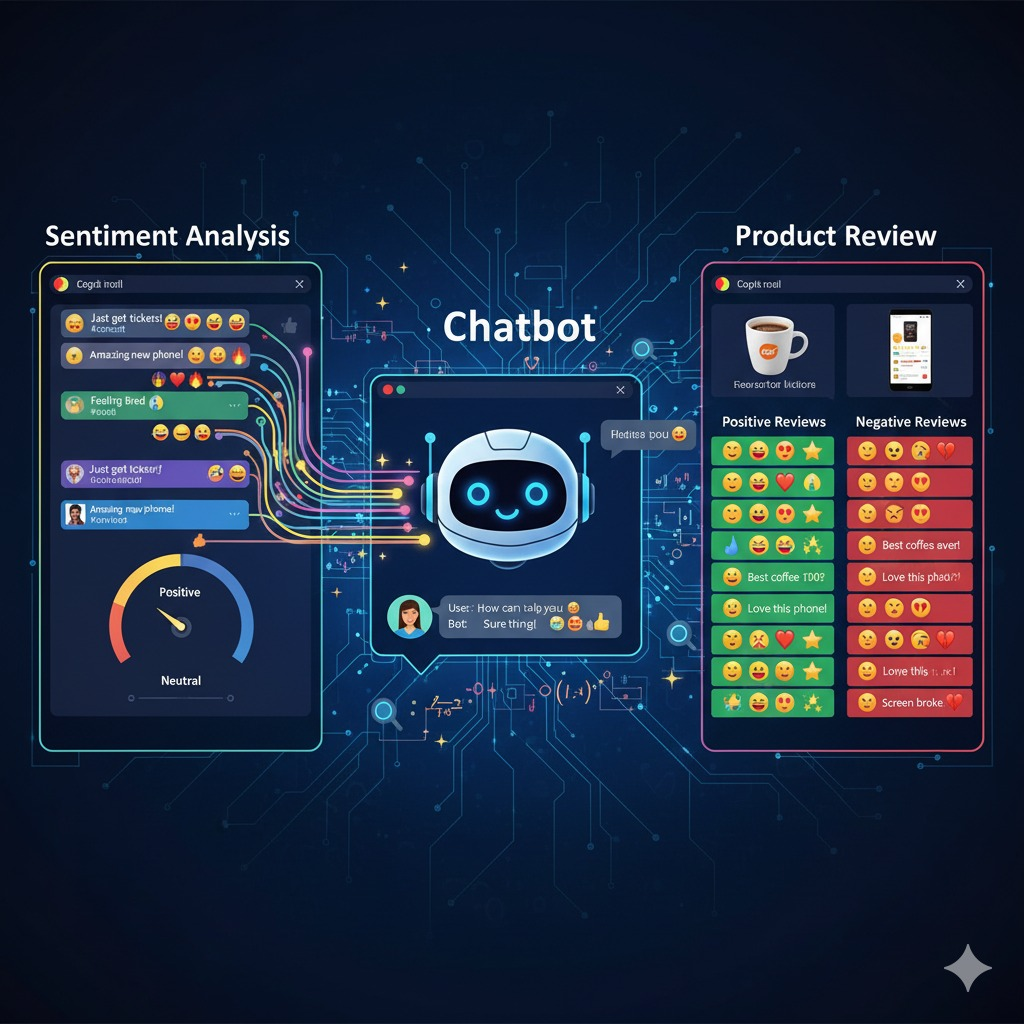
1. 🗨️ Social Media Sentiment Analysis
Social media platforms are emotional playgrounds — filled with praise, sarcasm, frustration, and excitement.
NLP models analyze these posts to detect trends, opinions, and moods.
For instance:
- “That concert was 🔥🔥🔥” → Highly positive
- “New update 😡 total fail” → Strongly negative
By handling emojis correctly, systems can interpret the real sentiment behind words — providing brands with valuable insights about their audiences.
2. 🤖 Chatbots & Virtual Assistants
Chatbots must understand informal human language — emojis, abbreviations, and tone included.
When a user sends “Thanks 😊”, the bot should recognize gratitude, not just the word “thanks”.
Effective emoji handling and normalization allow chatbots to:
- Respond empathetically.
- Detect user frustration or happiness.
- Personalize responses to emotional tone.
Example:
User: “That didn’t help 😔”
Bot: “I’m sorry to hear that. Let me try again.”
Without emoji interpretation, such emotional awareness wouldn’t be possible.
3. ⭐ Product Review Analysis
Online reviews often mix text and emojis:
“Battery life is amazing 🔋🔥” or “Camera quality 😕 not great.”
By cleaning and interpreting these mixed signals, NLP systems extract genuine insights about customer satisfaction, enabling smarter business decisions.
4. 📰 Brand Reputation Monitoring
Companies use NLP pipelines to monitor brand mentions across platforms.
Preprocessing ensures that even informal language, sarcasm, and emojis are captured accurately — turning chaotic social chatter into measurable sentiment data.
5. 📈 Market Research and Trend Analysis
NLP helps researchers study collective emotions — from stock market reactions to political opinions.
Emoji-rich data from platforms like X (Twitter) or TikTok reveals how public sentiment evolves in real time.
Without robust preprocessing, such large-scale emotional analysis would be impossible.
⚙️ The Hidden Power of Clean Data
It’s often said that “Garbage in, garbage out.”
In NLP, this couldn’t be truer. Even the most advanced AI model can fail if fed messy, inconsistent text.
Clean, preprocessed data:
- Reduces noise and confusion.
- Improves model accuracy and performance.
- Ensures consistent tokenization and vocabulary.
- Captures true emotional and semantic meaning.
When you handle emojis, normalize text, and standardize formats, you’re not just cleaning data — you’re teaching machines how to understand human behavior.
🧩 The Connection Between Emojis, Emotions, and AI
Emojis are more than decoration — they’re digital emotions.
In the world of NLP, they help bridge the gap between data and empathy.
As sentiment models evolve, emoji understanding plays a key role in:
- Emotion detection: Recognizing joy, sadness, sarcasm, or anger.
- Human-computer interaction: Making AI assistants more relatable.
- Cross-cultural communication: Interpreting emotions universally, beyond language barriers.
In the near future, NLP systems won’t just read our words — they’ll feel our tone, thanks to the way we handle emotional symbols like emojis.
🌈 Conclusion – Clean Text, Clear Insights
Text preprocessing is more than a technical step — it’s the foundation of understanding in NLP.
From removing noise to interpreting emotion, it transforms chaotic human expression into structured intelligence.
Handling emojis thoughtfully ensures that emotions are not lost in translation, while normalization guarantees that machines can process text consistently and effectively.
Whether you’re analyzing tweets, powering chatbots, or building recommendation systems — clean, well-preprocessed text is the key to smarter, more human-like AI.
So next time you send “Great work 👍🔥”, remember —
Those little symbols might just be teaching the next AI how to feel.
Next Step – Explore Services with Craze Neurons
When we look at the path to growing our skills, career, or business, we find that it is not only about time or effort but about the ways in which we use guidance, tools, and experience. At Craze Neurons, we offer a set of services that can act as a lens into knowledge, performance, and opportunity. Through these offerings, we can see the depth of learning and the perspective that comes from practical engagement.
- Upskilling Training – We provide hands-on training in Data Science, Python, AI, and related fields. This is a way for us to look at learning from both practical and conceptual perspectives.
👉 Click here to know more: https://wa.me/918368195998?text=I%20want%20to%20Upskill%20with%20Craze%20Neurons - ATS-Friendly Resume – Our team can craft resumes that are optimized for Applicant Tracking Systems (ATS), highlighting skills, experiences, and achievements. This service is available at ₹599, providing a tangible way for us to make first impressions count.
👉 Click here to know more: https://wa.me/918368195998?text=I%20want%20an%20ATS-Friendly%20Resume%20from%20Craze%20Neurons - Web Development – We build responsive, SEO-friendly websites that can be a framework for growth. It is a way for us to put ideas into structure, visibility, and functionality.
👉 Click here to know more: https://wa.me/918368195998?text=I%20want%20a%20Website%20from%20Craze%20Neurons - Android Projects – These are real-time projects designed with the latest tech stack, allowing us to learn by doing. Guided mentorship gives us a chance to look at development from a practical lens and to understand the why behind each decision.
👉 Click here to know more: https://wa.me/918368195998?text=I%20want%20an%20Android%20Project%20with%20Guidance - Digital Marketing – We provide campaigns in SEO, social media, content, and email marketing, which can be used to see our brand’s reach and engagement from a deeper perspective.
👉 Click here to know more: https://wa.me/918368195998?text=I%20want%20Digital%20Marketing%20Support - Research Writing – We deliver plagiarism-free thesis, reports, and papers, which can help us explore knowledge, present ideas, and communicate insight with clarity.
👉 Click here to know more: https://wa.me/918368195998?text=I%20want%20Research%20Writing%20Support
In all these services, we can see that learning, building, promoting, or publishing is not just a task but a process of discovery. It is a way for us to understand, measure, and reflect on what is possible when guidance meets effort.
❓ Frequently Asked Questions (FAQs) – Craze Neurons Services
1. What is included in the Upskilling Training?
We provide hands-on training in Data Science, Python, AI, and allied fields. This allows us to work with concepts and projects, see practical applications, and explore the deeper understanding of each topic.
2. How does the ATS-Friendly Resume service work?
Our team crafts ATS-optimized resumes that highlight skills, experience, and achievements. This is a service priced at ₹599 and acts as a lens to make the first impression clear, measurable, and effective.
3. What kind of websites can Craze Neurons build?
We build responsive and SEO-friendly websites for businesses, personal portfolios, and e-commerce platforms. This enables us to translate ideas into structure, visibility, and functional design.
4. What are the Android Projects about?
We offer real-time Android projects with guided mentorship. This gives us an opportunity to learn by doing, understand development from multiple angles, and apply knowledge in a controlled, real-world context.
5. What does Digital Marketing service include?
Our service covers SEO, social media campaigns, content marketing, and email strategy, allowing us to look at brand growth quantitatively and qualitatively, understanding what works and why.
6. What type of Research Writing do you provide?
We provide plagiarism-free academic and professional content, including thesis, reports, and papers. This allows us to express ideas, support arguments, and explore knowledge with depth and precision.
7. How can I get started with Craze Neurons services?
We can begin by clicking the WhatsApp link for the service we are interested in. This lets us communicate directly with the team and explore the steps together.
8. Can I use multiple services together?
Yes, we can combine training, resume, web, Android, digital marketing, and research services. This allows us to see synergies, plan strategically, and use resources effectively.
9. Is the training suitable for beginners?
Absolutely. The courses are designed for learners at all levels. They allow us to progress step by step, integrate projects, and build confidence alongside skills.
10. How long does it take to complete a service or course?
Duration depends on the service. Training programs vary by course length. Projects may take a few weeks, while resume, website, or research work can often be completed within a few days. This helps us plan, manage, and achieve outcomes efficiently.
Stay Connected with Us
🌐 Website: www.crazeneurons.com
📢 Telegram: https://t.me/cenjob
📸 Instagram: https://www.instagram.com/crazeneurons
💼 LinkedIn: https://www.linkedin.com/company/crazeneurons
▶️ YouTube:https://www.youtube.com/@CrazeNeurons
📲 WhatsApp: +91 83681 95998