A Data Analysis on Neural Network Interest, Growth, and AI Awareness Worldwide
1. Introduction
Alright, let’s just admit it—we’re all a little lost sometimes when it comes to AI. Seriously, two years ago, “neural networks” was just random tech jargon to me. The kind of phrase people drop at parties when they want to sound smart (and let’s be honest, a little smug). If you’d told me back then I’d write a huge blog about neural networks one day, I would’ve laughed hard enough to spill my chai.
But here we are. Fast forward to now, and it feels like everyone’s suddenly got questions. I’m talking about friends who still call me to reset their WiFi, my mom who’s convinced her phone is secretly listening to her, and my neighbor who thinks AI is all about robots from Hollywood movies. Even the uncle who still writes grocery lists by hand is now using Google to look up things like “What is a neural network?”
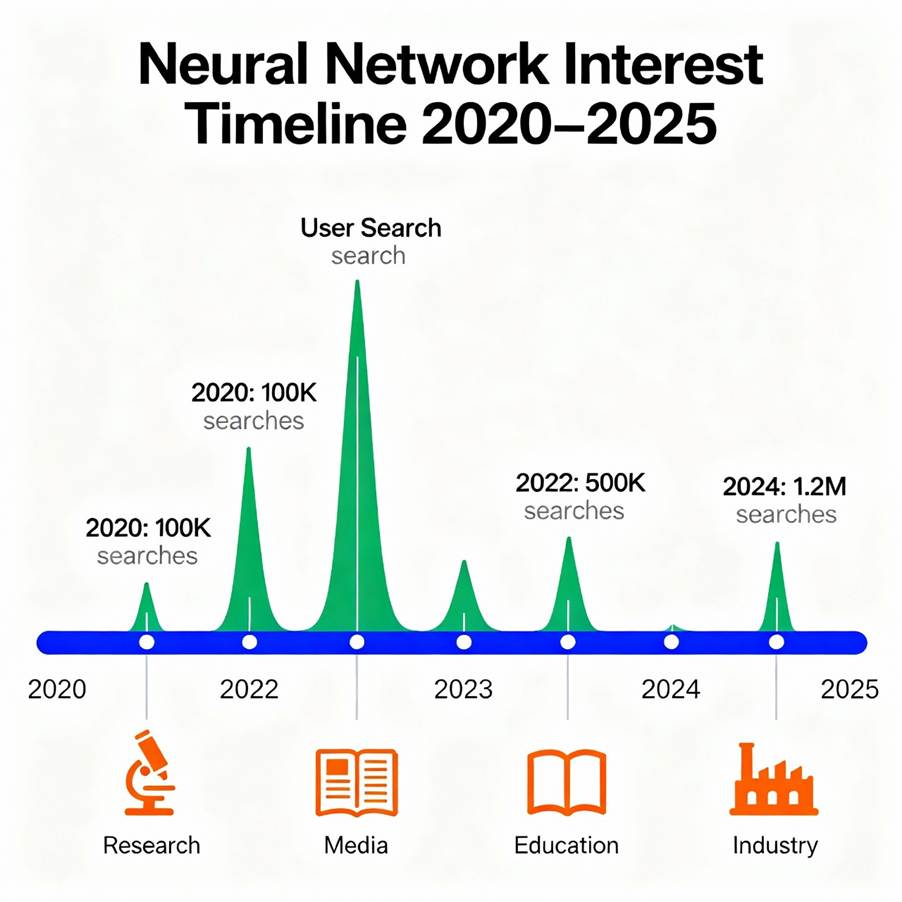
If you’ve ever found yourself lost or a little embarrassed to ask what these buzzwords really mean, trust me—you are NOT alone. Apparently, the whole world is right there with us. Google Trends is basically proof: from November 2020 to October 2025, there’s been a total explosion of curiosity around words like “Artificial Neural Networks,” “Neural Networks in AI,” and “What Is a Neural Network?” I mean, thank goodness for search engines, right?
2. Core Interest in ANNs
The funny thing is, if you look at the data from a couple years ago, it was—well, kind of sleepy. “Artificial Neural Networks” just kind of hummed along quietly, somewhere between 25 and 55 on the search charts. Like background music you only notice when it stops.
It reminds me of that one friend we all have… the quiet one at parties who suddenly, out of nowhere, becomes the life and soul when their favorite song comes on. For neural networks, their “jam” must have dropped in August 2025 because BOOM, the interest shot up to a perfect 100. Wild.
I still remember that time. Out of the blue, everyone and their cousin was throwing out neural network terms. I saw social media posts from people I didn’t even know had an email address five years ago, sharing articles about neural networks. Kids on the street suddenly arguing if AI could beat Messi at football or grandma at chess. (Honestly, I’d pay to watch both matches).
It wasn’t just offices or research labs anymore. It was… everywhere. And for maybe the first time, it wasn’t intimidating. It was kinda funny, sometimes even silly (“do neural networks have dreams?” someone asked on Reddit—not kidding).
3. Learning Basics: “What Is a Neural Network?”
Now, let’s rewind a bit. I’ll own up: the phrase “What is a neural network?” was in my search history. Multiple times. (Don’t judge.)
There’s something oddly comforting about those numbers: from 2021, thousands—probably millions—of us started googling the exact same basic question. The stats jumped from 9 to 15 in a heartbeat between August and October 2025, which, if you stop to think about it, basically means a crowd the size of several packed stadiums wanted to know what’s making their phones so “smart.”
Honestly, I remember late-night scrolling. I’d just given up on trying to learn the piano (again), when a YouTube recommendation hit: “Neural Networks Explained with Donuts.” No lie, I watched the whole thing. Was I more confused when it was over? Maybe a little. But it was the first time I laughed while learning AI stuff.
That’s the magic, isn’t it? At some point, learning about neural networks went from being exclusivity for “tech bros” to being fair game for anyone. Old, young, geek, technophobe—suddenly, it was okay to not know. Your first question didn’t have to be “deep.” It just had to be honest.
And let’s not forget the memes. I’ve lost count of how many AI-cat jokes I’ve shared with my group chats. If THAT doesn’t mean the subject is now part of everyday life, what does?
4. Neural Networks in AI Applications
After you’ve asked, “Hey, what IS this?” it’s only natural to wonder, “Okay, so what does it actually do for me?” And suddenly everyone was tying neural networks back to things they use every day. That’s when the questions got personal: Is AI in my phone? Is it the reason Netflix keeps nagging me to watch Korean dramas? Are these things listening to us?
Turns out, yeah… kind of. Neural networks quietly run under the hood in voice assistants (so, yes, that time Alexa randomly started playing ‘Happy Birthday’ was a neural net glitch), Spotify’s spooky-accurate song suggestions, or even your fitness tracker letting you know you haven’t moved from your couch in hours. (Ouch, by the way.)
Interest here started rising around 2022 and just kept growing. People everywhere—kids, teachers, random folks in line at coffee shops—started connecting the dots. “Ohhh, THAT’S neural networks working? I thought it was just magic.” Yeah, me too, buddy.
True story: My cousin’s five-year-old tried explaining to me how her drawing app “learned her style.” She said, “It’s like when my puppy knows his treat is coming.” Not bad, right? I’ve paid for worse explanations at “Expert” workshops.
5. Technical Curiosity: “What is an Artificial Neural Network”
Some people, bless them, are never satisfied with simple answers. You know these folks. The ones who watch ‘Explained’ on Netflix and immediately start reading the Wikipedia article. That’s when searches for “What is an Artificial Neural Network” started popping off in 2024 and 2025—hitting up towards 12 on the Google chart.
Was I one? Guilty. So are plenty of others. Sometimes it’s students prepping for job interviews, but a ton are just average people on a “Let’s see how deep this rabbit hole goes” mission.
I got nerdy. Really nerdy. Downloaded an e-book, tried (and miserably failed) to sketch a neural network on a napkin, pestered my coder friend with endless “dumb” questions until he had to mute me on WhatsApp. But you know what? Each tiny step made it all seem less intimidating.
And hey, not every search has to end in a PhD thesis. Sometimes understanding just a bit—like knowing that neural networks “learn” by being wrong a bunch of times—makes the whole technology world feel less mysterious, and more… ours.
6. 2025 Surge
Oh boy, July to September 2025? That was neural networks’ equivalent of going viral on TikTok. Seemingly every time I opened my phone, there was an article, a news report, or a group chat blowing up about AI. It felt less like tech news and more like a city-wide festival (minus the snacks, sadly).
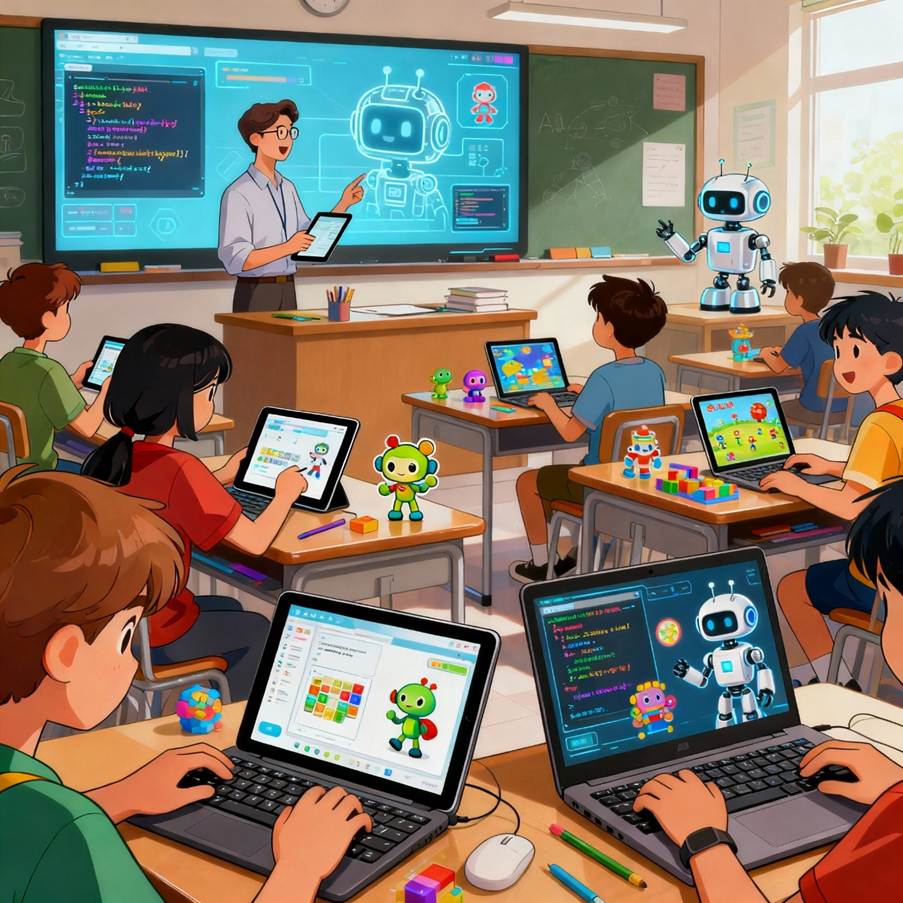
It wasn’t just news stories though. Whole companies launched new, ultra-user-friendly AI tools; suddenly, my aunt who’d sworn off Facebook was sharing AI-generated jokes. Teachers started “AI Hour”—not kidding—where kids played with simple coding tools at school.
Group chats everywhere were full of wild speculation (“Do you think AI will pick stocks for us?” “Should we be worried AI can fake my grandma’s voice?”). There was some fear, some skepticism, a LOT of excitement—and, let’s be real, a whole bunch of FOMO.
I saw people—actual adults—host “AI demo” parties, showing off the weirdest voice clones or silliest auto-generated images. At that point, generative AI wasn’t just a curiosity, it was a party trick.
And amidst all the hype, something remarkable happened: folks started demanding real education. They didn’t want just another viral tweet—they wanted tutorials, explainers, real talk. You could feel the shift from “this is so cool!” to “but how does this really work?” And that, to me, is the sweet spot.
7. Conclusion
So, where does this leave us? If you’re like me, it leaves you with a phone full of half-watched explainer videos, a brain buzzing with more tech questions than answers, and a sense of actual hope. Because wow, look how quickly we moved from “neural networks sound scary” to “let’s learn about this together.”
Maybe, just maybe, we’re past the phase where tech is only for “techies.” Now, even if you’re a baker, an artist, a teacher, or an accountant, you can ask out loud: “Why did the AI do that?” And someone will help you find out.
Will AI keep surprising us? For sure. Will neural networks keep evolving? No doubt. But now, it’s all less mysterious—and a little more fun. So next time you hear “neural network,” don’t roll your eyes, don’t zone out, and DEFINITELY don’t pretend to understand. Just ask. Laugh at what you don’t know. Share what you’ve learned.
Because the real “trend” Google didn’t capture? That feeling of thousands—maybe millions—of regular people learning something new, together, one question (and yes, one meme) at a time.
Your turn: What’s YOUR weirdest or funniest AI story? Have you ever tried to break a chatbot, or caught yourself explaining neural networks at a dinner party? Trust me, those moments are how we’ll all get smarter—one human story at a time.
Next Step – Explore Services with Craze Neurons
When we look at the path to growing our skills, career, or business, we find that it is not only about time or effort but about the ways in which we use guidance, tools, and experience. At Craze Neurons, we offer a set of services that can act as a lens into knowledge, performance, and opportunity. Through these offerings, we can see the depth of learning and the perspective that comes from practical engagement.
- Upskilling Training – We provide hands-on training in Data Science, Python, AI, and related fields. This is a way for us to look at learning from both practical and conceptual perspectives.
👉 Click here to know more: https://wa.me/918368195998?text=I%20want%20to%20Upskill%20with%20Craze%20Neurons - ATS-Friendly Resume – Our team can craft resumes that are optimized for Applicant Tracking Systems (ATS), highlighting skills, experiences, and achievements. This service is available at ₹599, providing a tangible way for us to make first impressions count.
👉 Click here to know more: https://wa.me/918368195998?text=I%20want%20an%20ATS-Friendly%20Resume%20from%20Craze%20Neurons - Web Development – We build responsive, SEO-friendly websites that can be a framework for growth. It is a way for us to put ideas into structure, visibility, and functionality.
👉 Click here to know more: https://wa.me/918368195998?text=I%20want%20a%20Website%20from%20Craze%20Neurons - Android Projects – These are real-time projects designed with the latest tech stack, allowing us to learn by doing. Guided mentorship gives us a chance to look at development from a practical lens and to understand the why behind each decision.
👉 Click here to know more: https://wa.me/918368195998?text=I%20want%20an%20Android%20Project%20with%20Guidance - Digital Marketing – We provide campaigns in SEO, social media, content, and email marketing, which can be used to see our brand’s reach and engagement from a deeper perspective.
👉 Click here to know more: https://wa.me/918368195998?text=I%20want%20Digital%20Marketing%20Support - Research Writing – We deliver plagiarism-free thesis, reports, and papers, which can help us explore knowledge, present ideas, and communicate insight with clarity.
👉 Click here to know more: https://wa.me/918368195998?text=I%20want%20Research%20Writing%20Support
In all these services, we can see that learning, building, promoting, or publishing is not just a task but a process of discovery. It is a way for us to understand, measure, and reflect on what is possible when guidance meets effort.
❓ Frequently Asked Questions (FAQs) – Craze Neurons Services
1. What is included in the Upskilling Training?
We provide hands-on training in Data Science, Python, AI, and allied fields. This allows us to work with concepts and projects, see practical applications, and explore the deeper understanding of each topic.
2. How does the ATS-Friendly Resume service work?
Our team crafts ATS-optimized resumes that highlight skills, experience, and achievements. This is a service priced at ₹599 and acts as a lens to make the first impression clear, measurable, and effective.
3. What kind of websites can Craze Neurons build?
We build responsive and SEO-friendly websites for businesses, personal portfolios, and e-commerce platforms. This enables us to translate ideas into structure, visibility, and functional design.
4. What are the Android Projects about?
We offer real-time Android projects with guided mentorship. This gives us an opportunity to learn by doing, understand development from multiple angles, and apply knowledge in a controlled, real-world context.
5. What does Digital Marketing service include?
Our service covers SEO, social media campaigns, content marketing, and email strategy, allowing us to look at brand growth quantitatively and qualitatively, understanding what works and why.
6. What type of Research Writing do you provide?
We provide plagiarism-free academic and professional content, including thesis, reports, and papers. This allows us to express ideas, support arguments, and explore knowledge with depth and precision.
7. How can I get started with Craze Neurons services?
We can begin by clicking the WhatsApp link for the service we are interested in. This lets us communicate directly with the team and explore the steps together.
8. Can I use multiple services together?
Yes, we can combine training, resume, web, Android, digital marketing, and research services. This allows us to see synergies, plan strategically, and use resources effectively.
9. Is the training suitable for beginners?
Absolutely. The courses are designed for learners at all levels. They allow us to progress step by step, integrate projects, and build confidence alongside skills.
10. How long does it take to complete a service or course?
Duration depends on the service. Training programs vary by course length. Projects may take a few weeks, while resume, website, or research work can often be completed within a few days. This helps us plan, manage, and achieve outcomes efficiently.
Stay Connected with Us
🌐 Website: www.crazeneurons.com
📢 Telegram: https://t.me/cenjob
📸 Instagram: https://www.instagram.com/crazeneurons
💼 LinkedIn: https://www.linkedin.com/company/crazeneurons
▶️ YouTube:https://www.youtube.com/@CrazeNeurons
📲 WhatsApp: +91 83681 95998