Introduction
Uninformed search algorithms explore a problem space without using domain knowledge.
They depend only on the problem structure and goal test. Each algorithm follows a different expansion strategy.
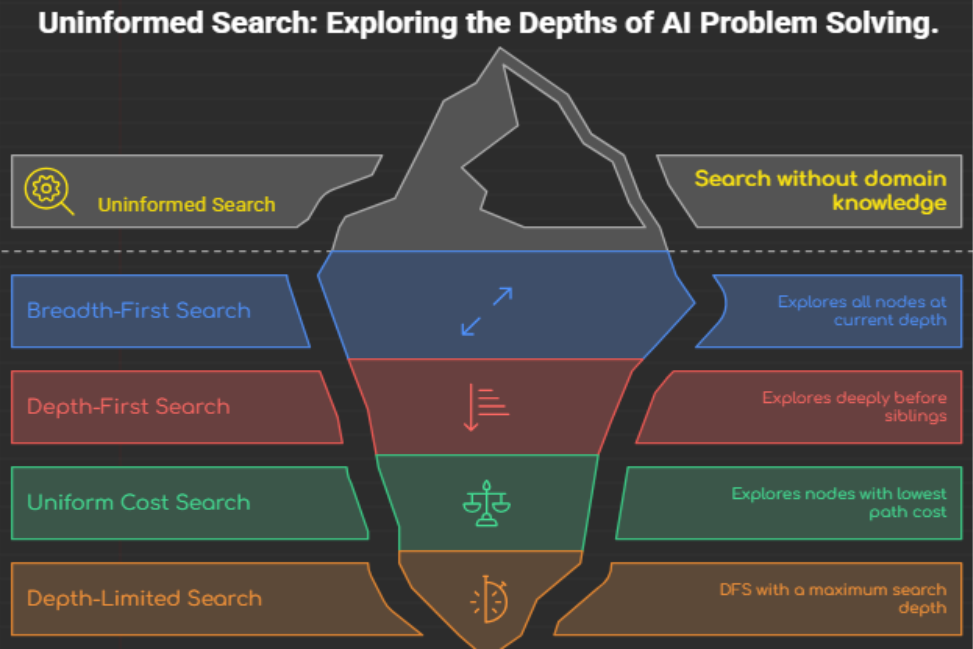
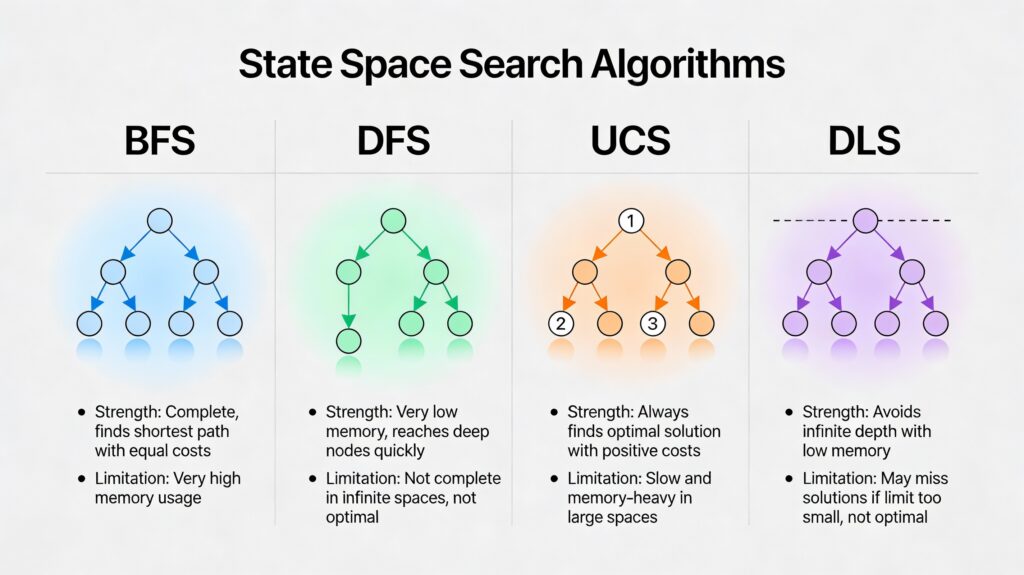
Breadth-First Search (BFS)
Breadth-First Search explores nodes level by level.
It expands all nodes at one depth before moving deeper.
The shallowest nodes are always explored first.
Advantages of BFS
BFS is complete.
It always finds a solution if one exists.
It finds the shortest path when all costs are equal.
Its behavior is predictable and systematic.
Limitations of BFS
Memory usage is very high.
All nodes at a level must be stored.
It becomes impractical for deep search spaces.
Time complexity increases rapidly with branching factor.
Depth-First Search (DFS)
Depth-First Search explores one branch deeply.
It backtracks only when no further expansion is possible.
It uses a stack-based approach.
Advantages of DFS
DFS uses very little memory.
It is easy to implement.
It can reach deep solutions quickly.
Limitations of DFS
DFS is not complete in infinite spaces.
It may get stuck in infinite paths.
It does not guarantee the shortest solution.
Solution quality depends on traversal order.
Uniform Cost Search (UCS)
Uniform Cost Search expands the lowest-cost path first.
It selects nodes based on cumulative path cost.
A priority queue controls expansion order.
Advantages of UCS
UCS always finds the optimal solution.
It works well with variable path costs.
It is complete for all positive step costs.
Limitations of UCS
UCS is slow for large search spaces.
Memory consumption is high.
Implementation is more complex.
Performance degrades when many paths have similar costs.
Depth-Limited Search (DLS)
Depth-Limited Search is a modified DFS.
It introduces a predefined depth limit.
Nodes beyond this limit are not expanded.
Advantages of DLS
DLS avoids infinite depth traversal.
Memory usage remains low.
It gives control over search depth.
It is efficient when solution depth is known.
Limitations of DLS
DLS is not complete if the limit is too small.
It may miss valid solutions.
It does not guarantee optimality.
Choosing the correct depth limit is difficult.
Comparative Insight
BFS prioritizes completeness.
DFS prioritizes memory efficiency.
UCS prioritizes cost optimality.
DLS prioritizes controlled exploration.
These algorithms represent different design trade-offs.
Understanding them is essential for effective AI problem solving.
Comparison of Common Uninformed Search Algorithms
| Feature | Breadth-First Search (BFS) | Depth-First Search (DFS) | Uniform Cost Search (UCS) | Depth-Limited Search (DLS) |
| Search strategy | Explores level by level | Explores one branch deeply | Expands lowest-cost path | DFS with a depth limit |
| Uses domain knowledge | No | No | No | No |
| Data structure used | Queue | Stack / Recursion | Priority queue | Stack with depth counter |
| Completeness | Yes | No (in infinite spaces) | Yes | Only if solution depth ≤ limit |
| Optimality | Yes (equal cost only) | No | Yes | No |
| Memory usage | Very high | Very low | High | Low |
| Time efficiency | Slow for large depth | Can be fast or slow | Slow due to cost comparison | Faster than DFS in deep spaces |
| Risk of infinite loops | No | High | No | Low |
| Control over depth | No | No | No | Yes |
| Best suited for | Shallow solutions | Memory-limited problems | Variable-cost problems | Known or estimated depth |
| Main limitation | Memory explosion | May never find solution | High time and memory cost | Misses deep solutions |
Key Insight
Each algorithm solves a different problem type.
No single method is best for all cases.
Depth-Limited Search offers a practical balance.
It controls infinite depth while preserving low memory use.
Your Next Step: Turn Learning Into Real Outcomes
Learning creates understanding. Progress comes from applying it with the right guidance. Use the table below to identify your immediate goal, understand what support fits best, and take a clear next step with Craze Neurons.
| What You Need Right Now! | What This Service Helps You Achieve | Starting At | Next Step |
| Upskilling Training | Real-world capability in Data Science, Python, AI, and related fields through hands-on training, live projects, mentorship, and strong conceptual grounding. | ₹2000 | 👉 Start upskilling |
| ATS-Friendly Resume | An ATS-optimized resume that reaches recruiters, built using skill-focused structuring and precise keyword optimization aligned with hiring systems. | ₹599 | 👉 Get an ATS-ready resume |
| Web Development | A responsive, SEO-friendly website designed for visibility and growth, using performance-driven design, clean structure, and search readiness. | ₹5000 | 👉Get Web site support |
| Android Projects | Practical Android development experience gained through real-time projects, guided mentorship, and clear explanations behind technical decisions. | ₹10000 | 👉 Get Android support |
| Digital Marketing | Increased brand visibility and engagement achieved through data-driven SEO, content strategy, social media, and email marketing campaigns. | ₹5000 | 👉 Get digital marketing support |
| Research Writing | Clear, plagiarism-free academic and technical writing delivered through structured, original research with academic integrity. | ₹5000 | 👉 Get research writing support |
❓ Frequently Asked Questions (FAQs) – Craze Neurons Services
0. Not sure which option fits your situation?
A short discussion is often enough to identify the most effective path. We help you clarify scope, effort, and outcomes before you commit.
👉 Talk to Craze Neurons on WhatsApp
1. What is included in the Upskilling Training?
We provide hands-on training in Data Science, Python, AI, and allied fields. This allows us to work with concepts and projects, see practical applications, and explore the deeper understanding of each topic.
2. How does the ATS-Friendly Resume service work?
Our team crafts ATS-optimized resumes that highlight skills, experience, and achievements. This is a service priced at ₹599 and acts as a lens to make the first impression clear, measurable, and effective.
3. What kind of websites can Craze Neurons build?
We build responsive and SEO-friendly websites for businesses, personal portfolios, and e-commerce platforms. This enables us to translate ideas into structure, visibility, and functional design.
4. What are the Android Projects about?
We offer real-time Android projects with guided mentorship. This gives us an opportunity to learn by doing, understand development from multiple angles, and apply knowledge in a controlled, real-world context.
5. What does Digital Marketing service include?
Our service covers SEO, social media campaigns, content marketing, and email strategy, allowing us to look at brand growth quantitatively and qualitatively, understanding what works and why.
6. What type of Research Writing do you provide?
We provide plagiarism-free academic and professional content, including thesis, reports, and papers. This allows us to express ideas, support arguments, and explore knowledge with depth and precision.
7. How can I get started with Craze Neurons services?
We can begin by clicking the WhatsApp link for the service we are interested in. This lets us communicate directly with the team and explore the steps together.
8. Can I use multiple services together?
Yes, we can combine training, resume, web, Android, digital marketing, and research services. This allows us to see synergies, plan strategically, and use resources effectively.
9. Is the training suitable for beginners?
Absolutely. The courses are designed for learners at all levels. They allow us to progress step by step, integrate projects, and build confidence alongside skills.
10. How long does it take to complete a service or course?
Duration depends on the service. Training programs vary by course length. Projects may take a few weeks, while resume, website, or research work can often be completed within a few days. This helps us plan, manage, and achieve outcomes efficiently.
Stay Connected with Us
🌐 Website 📢 Telegram 📸 Instagram 💼 LinkedIn ▶️ YouTube 📲 WhatsApp: +91 83681 95998