How Uncertainty Becomes Computable in Intelligent Systems
Introduction
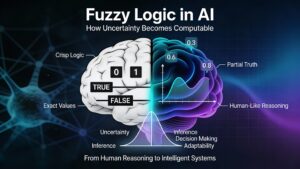
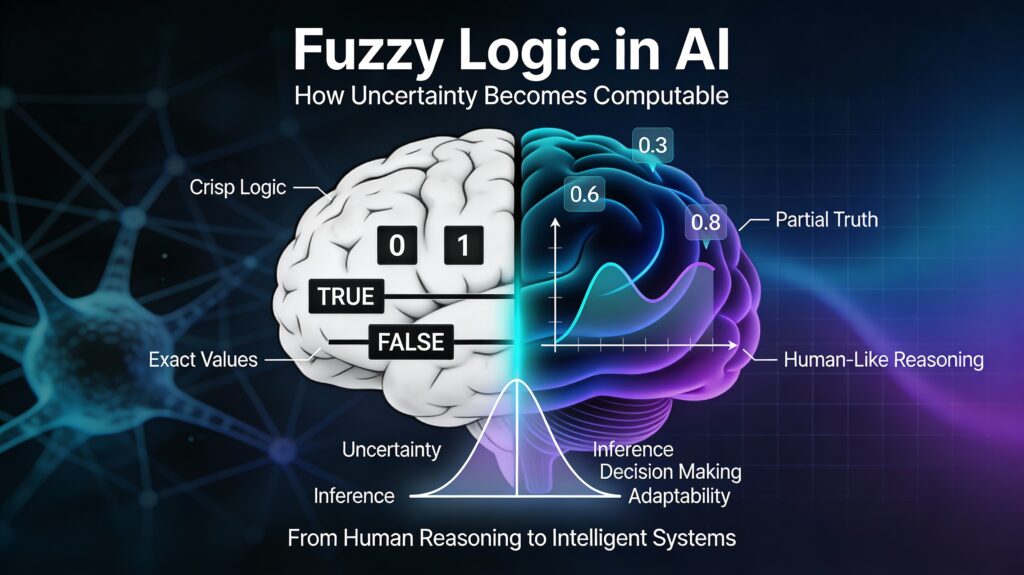
In the real world, information does not usually come as a simple black or white choice. The terms hot, tall, fast, or safe are some examples of concepts that do not have sharp and clearly defined boundaries. People can reason very well when there is such uncertainty, but traditional computer systems have a problem with that because they are working with just the exact true or false values. The gap that exists between humans and machines is closed by Fuzzy Logic, a major division of Artificial Intelligence (AI) that allows computers to think like humans to some extent.
Fuzzy Logic takes the uncertainty and makes it something that can be computed, thus allowing the intelligent systems to perform quite well even in the most complex and real-life situations. The blog contains a practical introduction to fuzzy logic, its main concepts, functions, and importance in the real world.
What Is Fuzzy Logic?
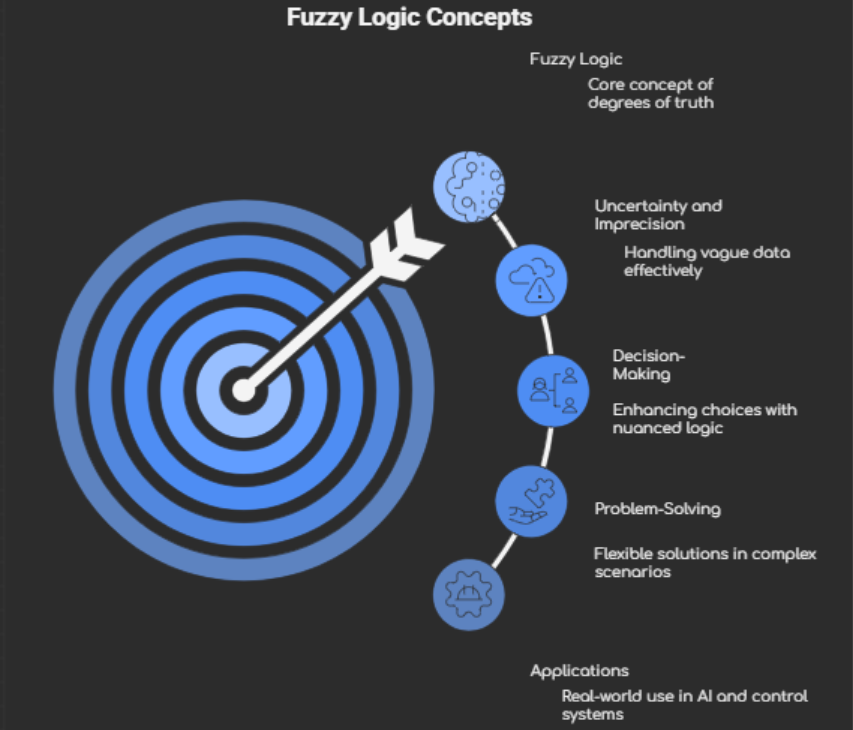
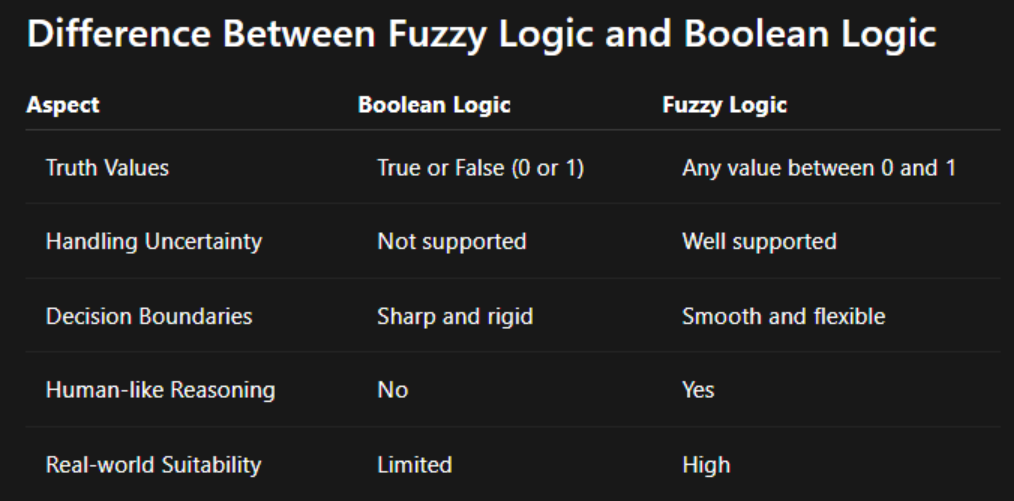
Fuzzy Logic is one type of multi-valued logic that was introduced by Lotfi A. Zadeh in 1965. While classical Boolean logic allows only two values, namely true (1) and false (0), fuzzy logic provides a whole range of truth values from 0 to 1.
Such an advantage makes it possible for the systems to show indistinct, inaccurate, or doubtful information in a manner that is mathematically significant.
Concept of Fuzzy Sets
In classical set theory, an element can either belong to a set or not. Fuzzy logic takes one step further by introducing fuzzy sets where the elements can belong to the set to a certain degree.
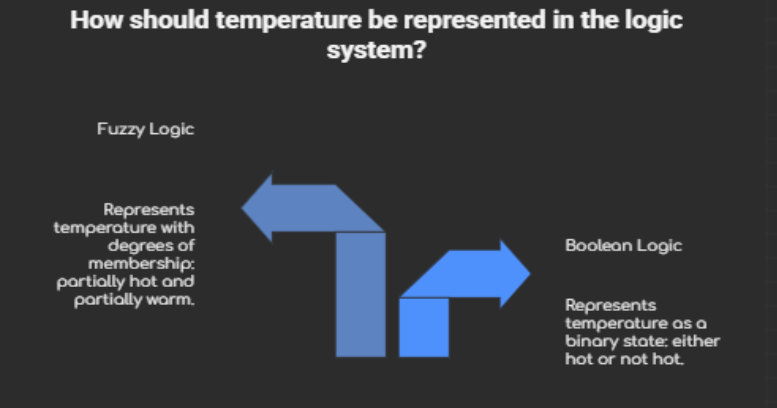
Example
Contemplate the temperature concept:
- In Boolean logic: 30°C is simply categorized as hot or not hot.
- In fuzzy logic: 30°C can be half hot and half warm.
A fuzzy set member is assigned a membership value of 0 to 1, signifying its extent of inclusion in that set.
Membership Functions
A member of a fuzzy set maps an input into a degree of membership. The mathematical underpinning of fuzzy set theory is membership functions.
Common Types of Membership Functions
- Triangular – Easy to understand and highly common
- Trapezoidal – Good for values based on intervals
- Gaussian – Smooth and natural changes over time
- Sigmoid – Best for slow development curves
Purpose
It is membership functions that help in the conversion of real-world inputs like temperature, speed, and pressure into fuzzy values processed by the system.
Fuzzy Inference Mechanisms
A Fuzzy Inference System (FIS) decision using fuzzy logic. A fuzzy reasoning system based on the fuzzy input operated by rules simulating the reasoning of a human.
Main Steps in Fuzzy Inference
- Fuzzification
Transforms sharp input values to fuzzy values through the use of membership functions.
- Rule Evaluation
Executes a group of IF-THEN rules, for instance:
IF temperature is high AND humidity is high, THEN fan speed is fast.
- Aggregation
Unites the results of all the rules that were applicable.
- Defuzzification
Turns the fuzzy output into a crisp, actionable value.
Popular Fuzzy Inference Models
- Mamdani Model – Simple and often used in control systems
- Sugeno Model – Fast and fit for adaptive systems
Real-World Applications of Fuzzy Logic
Fuzzy logic is a method that finds its application in systems where it is almost impossible to get a precise mathematical model.
Main Applications
- Consumer Electronics: Washing machines, air conditioners, and cameras
- Automotive Systems: Automatic transmission and braking systems
- Healthcare: Medical diagnosis and treatment recommendations
- Industrial Control: Process control and robotics
- Artificial Intelligence: Expert systems and decision-making models
The usage of fuzzy logic in these applications is due to the handling of uncertainty and human-like judgment.
Why Fuzzy Logic Matters in AI
Fuzzy logic is an integral part of AI, as it allows the systems to:
- Handle imperfect or vague information
- Make decisions in a flexible manner
- Use human concepts in a natural way
Additionally, it collaborates with other AI methods like machine learning and neural networks, particularly in rule-based decision systems.
Conclusion
Fuzzy Logic changes the whole scenario of uncertainty from a drawback to a strong computational tool. Uncertainty is transformed into a computational tool. Fuzzy sets, membership functions, and inference mechanisms are introduced to make the intelligent system work in the rare clarity and common ambiguity environments.
Fuzzy logic is still in the limelight as a technique for making thinking systems that are less machine-like and more human-like even as AI gradually advances technically.
For deeper context and practical extensions across AI, data science, automation, Python, careers, and industry trends, explore these related reads:https://crazeneurons.com/2025/08/18/ai-in-cricket-a-shared-look-into-the-numbers-behind-the-game/, https://crazeneurons.com/2025/08/03/future-of-data-analytics-in-2025-top-trends-tools-career-skills-industry-insights/, https://crazeneurons.com/2025/08/02/why-learning-data-analysis-data-science-and-ai-matters-in-todays-world/, https://crazeneurons.com/2025/08/02/why-learning-data-analysis-data-science-and-ai-matters-in-todays-world/, https://crazeneurons.com/2025/08/19/ai-interview-questions/, https://crazeneurons.com/2025/08/20/what-is-automation-trends-future-and-impact-on-jobs/, https://crazeneurons.com/2025/08/21/data-analysis-tools-and-data-visualization-software/, https://crazeneurons.com/2025/08/27/resume-maker-2025-ats-friendly/, https://crazeneurons.com/2025/09/02/generative-ai-and-agentic-ai/, https://crazeneurons.com/2025/09/08/ats-friendly-resume-guide/, https://crazeneurons.com/2025/09/15/types-of-data-in-data-science/, https://crazeneurons.com/2025/09/27/ai-everywhere-india/, https://crazeneurons.com/2025/10/03/ai-business-automation-india-future/, https://crazeneurons.com/2025/10/08/applications-of-python-2025/, https://crazeneurons.com/swot-analysis-guide-business/, https://crazeneurons.com/web-scraping-python-beginners-guide/, https://crazeneurons.com/2025/10/28/natural-language-processing-nlp-with-nltk-sequence-analysis-real-life-examples/, https://crazeneurons.com/2025/10/30/handling-emojis-text-preprocessing-in-nlp/, https://crazeneurons.com/2025/10/31/normalization-in-nlp-machine-learning-data-science-techniques-and-applications/, https://crazeneurons.com/2025/11/01/job-satisfaction-human-physiology-and-organizational-behaviour/, https://crazeneurons.com/2025/11/02/top-machine-learning-trends-applications-algorithms-and-types-explained/, https://crazeneurons.com/2025/11/03/ai-history-trends-why-we-all-started-googling-the-ai-backstory/, https://crazeneurons.com/2025/11/04/global-neural-network-trends-rising-curiosity-in-artificial-neural-networks-and-ai-learning/, https://crazeneurons.com/2025/11/15/misconceptions-about-artificial-intelligence/, https://crazeneurons.com/2025/11/16/python-for-data-analysis/, https://crazeneurons.com/2025/11/17/how-python-changed-my-work-and-made-data-less-scary/, https://crazeneurons.com/2025/11/24/business-intelligence-workshop-excel-power-bi-training/, https://crazeneurons.com/2025/12/06/top-python-libraries-every-data-analyst-should-know/, https://crazeneurons.com/2025/12/12/job-ready-python-for-data-analysis-6-month-roadmap/.
Next Step – Explore Services with Craze Neurons
When we look at the path to growing our skills, career, or business, we find that it is not only about time or effort but about the ways in which we use guidance, tools, and experience. At Craze Neurons, we offer a set of services that can act as a lens into knowledge, performance, and opportunity. Through these offerings, we can see the depth of learning and the perspective that comes from practical engagement.
- Upskilling Training – We provide hands-on training in Data Science, Python, AI, and related fields. This is a way for us to look at learning from both practical and conceptual perspectives.
👉 Click here to know more: https://wa.me/918368195998?text=I%20want%20to%20Upskill%20with%20Craze%20Neurons - ATS-Friendly Resume – Our team can craft resumes that are optimized for Applicant Tracking Systems (ATS), highlighting skills, experiences, and achievements. This service is available at ₹599, providing a tangible way for us to make first impressions count.
👉 Click here to know more: https://wa.me/918368195998?text=I%20want%20an%20ATS-Friendly%20Resume%20from%20Craze%20Neurons - Web Development – We build responsive, SEO-friendly websites that can be a framework for growth. It is a way for us to put ideas into structure, visibility, and functionality.
👉 Click here to know more: https://wa.me/918368195998?text=I%20want%20a%20Website%20from%20Craze%20Neurons - Android Projects – These are real-time projects designed with the latest tech stack, allowing us to learn by doing. Guided mentorship gives us a chance to look at development from a practical lens and to understand the why behind each decision.
👉 Click here to know more: https://wa.me/918368195998?text=I%20want%20an%20Android%20Project%20with%20Guidance - Digital Marketing – We provide campaigns in SEO, social media, content, and email marketing, which can be used to see our brand’s reach and engagement from a deeper perspective.
👉 Click here to know more: https://wa.me/918368195998?text=I%20want%20Digital%20Marketing%20Support - Research Writing – We deliver plagiarism-free thesis, reports, and papers, which can help us explore knowledge, present ideas, and communicate insight with clarity.
👉 Click here to know more: https://wa.me/918368195998?text=I%20want%20Research%20Writing%20Support
In all these services, we can see that learning, building, promoting, or publishing is not just a task but a process of discovery. It is a way for us to understand, measure, and reflect on what is possible when guidance meets effort.
❓ Frequently Asked Questions (FAQs) – Craze Neurons Services
1. What is included in the Upskilling Training?
We provide hands-on training in Data Science, Python, AI, and allied fields. This allows us to work with concepts and projects, see practical applications, and explore the deeper understanding of each topic.
2. How does the ATS-Friendly Resume service work?
Our team crafts ATS-optimized resumes that highlight skills, experience, and achievements. This is a service priced at ₹599 and acts as a lens to make the first impression clear, measurable, and effective.
3. What kind of websites can Craze Neurons build?
We build responsive and SEO-friendly websites for businesses, personal portfolios, and e-commerce platforms. This enables us to translate ideas into structure, visibility, and functional design.
4. What are the Android Projects about?
We offer real-time Android projects with guided mentorship. This gives us an opportunity to learn by doing, understand development from multiple angles, and apply knowledge in a controlled, real-world context.
5. What does Digital Marketing service include?
Our service covers SEO, social media campaigns, content marketing, and email strategy, allowing us to look at brand growth quantitatively and qualitatively, understanding what works and why.
6. What type of Research Writing do you provide?
We provide plagiarism-free academic and professional content, including thesis, reports, and papers. This allows us to express ideas, support arguments, and explore knowledge with depth and precision.
7. How can I get started with Craze Neurons services?
We can begin by clicking the WhatsApp link for the service we are interested in. This lets us communicate directly with the team and explore the steps together.
8. Can I use multiple services together?
Yes, we can combine training, resume, web, Android, digital marketing, and research services. This allows us to see synergies, plan strategically, and use resources effectively.
9. Is the training suitable for beginners?
Absolutely. The courses are designed for learners at all levels. They allow us to progress step by step, integrate projects, and build confidence alongside skills.
10. How long does it take to complete a service or course?
Duration depends on the service. Training programs vary by course length. Projects may take a few weeks, while resume, website, or research work can often be completed within a few days. This helps us plan, manage, and achieve outcomes efficiently.
Stay Connected with Us
🌐 Website: www.crazeneurons.com
📢 Telegram: https://t.me/cenjob
📸 Instagram: https://www.instagram.com/crazeneurons
💼 LinkedIn: https://www.linkedin.com/company/crazeneurons
▶️ YouTube:https://www.youtube.com/@CrazeNeurons
📲 WhatsApp: +91 83681 95998