Introduction
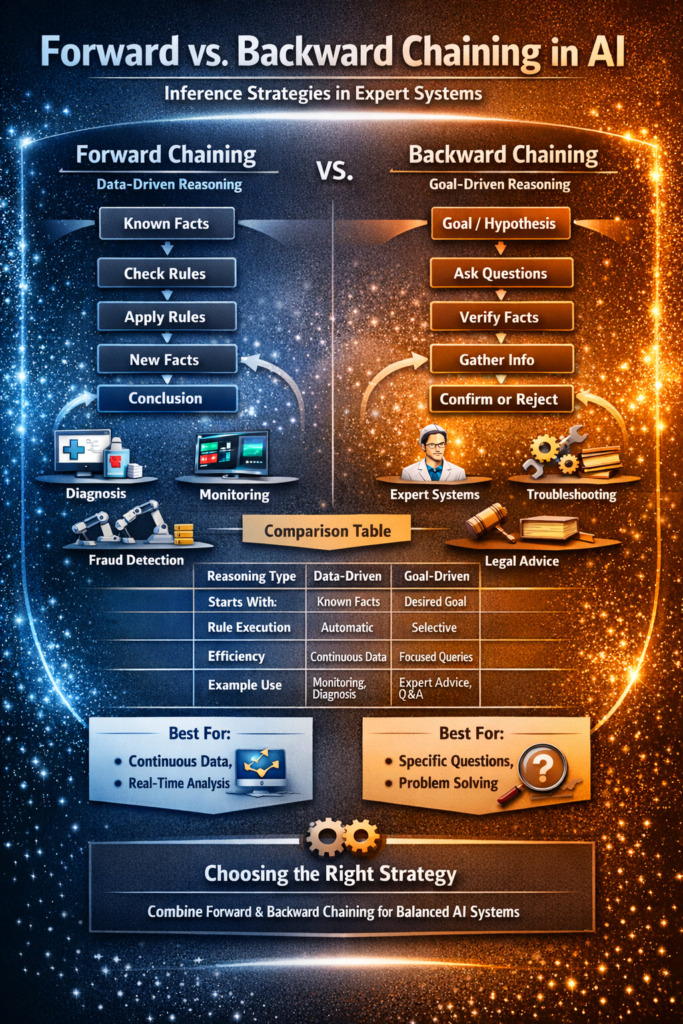
The expert systems in Artificial Intelligence use logical reasoning to make decisions while their learning process depends on data analysis. The two main inference strategies of this reasoning system operate through its two main methods of Forward Chaining and Backward Chaining.
The two methods activate knowledge base rules through different mechanisms which results in distinct reasoning pathways that show specific situations where each method performs best. The selection of proper strategies plays a vital role in developing systems that operate efficiently while demonstrating advanced intelligence.
Understanding Inference in Expert Systems
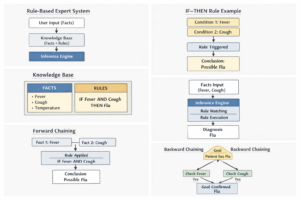
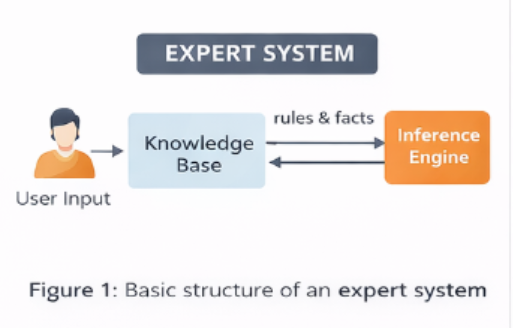
An expert system consists of:
• A Knowledge Base (facts + rules)
• An Inference Engine (reasoning mechanism)
The inference engine determines the timing and selection of rules through its implementation of forward and backward chaining.
Rule Triggering Process
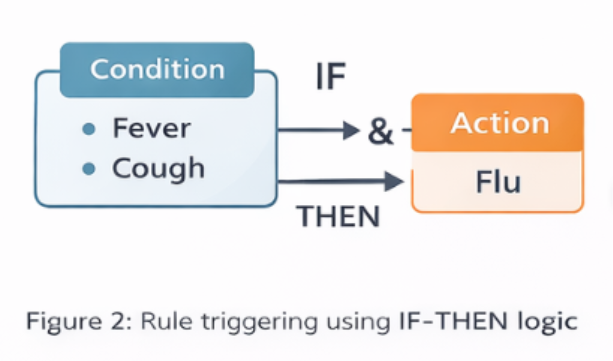
A rule is triggered when its conditions are satisfied.
Basic Rule Format
IF condition(s) THEN action(s)
Once the conditions set up for the rules are satisfied, the rule is triggered itself.
The difference between backward and forward chaining rests on the point at which the system verifies these conditions.
Forward Chaining (Data-Driven Reasoning)
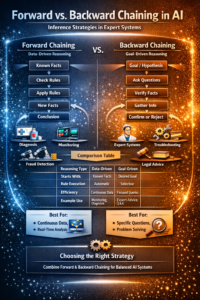
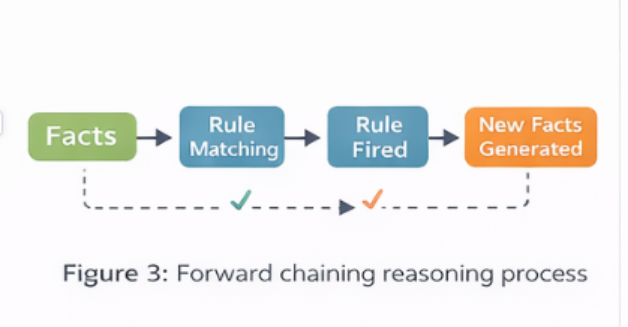
Forward chaining starts from known facts and moves step by step toward a conclusion.
How Forward Chaining Works
• The system stores facts into its working memory
• The inference engine checks which rules match the facts
• The system fires rules that match the current conditions
• The system creates new facts through its operations
• The process repeats until the system reaches its conclusion point
Example in an Expert System
Facts:
Patient has fever
Patient has cough
Rule:
IF fever AND cough → flu
Conclusion:
Patient may have flu
Key Characteristics
• Data-driven approach
• The system performs an automatic search through every potential outcome.
• The system operates effectively in environments which experience constant changes.
Common Use Cases
• Medical diagnosis systems
• Real-time monitoring
• Fraud detection systems
• Industrial automation
Backward Chaining (Goal-Driven Reasoning)
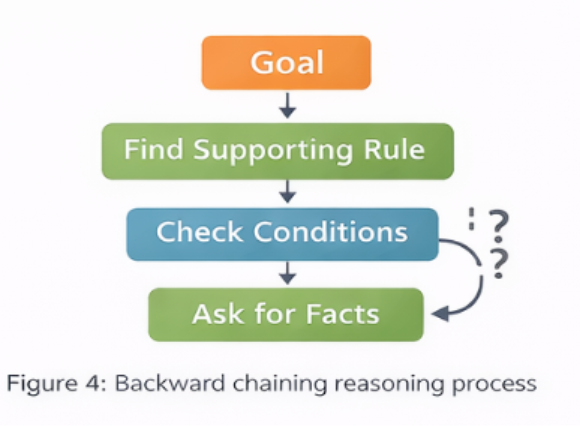
Backward chaining functions with the premise of a goal or hypothesis, discovering the validity of real facts that might support it.
How Backward Chaining Works
• A goal is defined
• The system searches for rules that can achieve the goal
• The system tests whether all rule conditions have been met
• The system requests additional information or conducts data searches when it encounters missing facts
• The system determines whether to confirm or reject the established goal.
Example in an Expert System
Goal:Does the patient have the flu?
Rule:IF fever AND cough → flu
Verification:
Does the patient have a fever?
Does the patient have a cough?
Conclusion:Patient has flu
Key Characteristics
• Goal-driven approach
• The system performs efficient, focused searches.
• The system executes only essential rules which help to decrease unnecessary processing.
Common Use Cases
• Expert systems
• Troubleshooting systems
• Question-answer systems
• Legal and advisory systems
Comparison Table
| Feature | Forward Chaining | Backward Chaining |
| Reasoning Type | Data-driven | Goal-driven |
| Starts With | Known facts | Desired goal |
| Rule Execution | Automatic | Selective |
| Efficiency | Best for continuous data | Best for focused queries |
| Example Use | Monitoring, diagnosis | Expert advice, Q&A |
Choosing the Right Strategy
Advantages of Forward Chaining are:
• Continuously generated data
• All interpretations must be examined at least once
Backward chaining is preferred when:
• A specific question requires an answer
• Systems should require interaction.
Expert systems nowadays make use of a combination of two strategies to achieve a balance between performance and accuracy.
Conclusion
Forward and backward chaining serve as essential reasoning methods which artificial intelligence systems use to create expert systems. The strength of forward chaining lies in its ability to handle extensive data while backward chaining proves most effective for solving specific problems. The ability to understand their differences allows developers and analysts to create systems which demonstrate both intelligent behavior and efficient performance.
For deeper context and practical extensions across AI, data science, automation, Python, careers, and industry trends, explore these related articles:
Your Next Step: Turn Learning Into Real Outcomes
Learning creates understanding. Progress comes from applying it with the right guidance. Use the table below to identify your immediate goal, understand what support fits best, and take a clear next step with Craze Neurons.
| What You Need Right Now! | What This Service Helps You Achieve | Starting At | Next Step |
| Upskilling Training | Real-world capability in Data Science, Python, AI, and related fields through hands-on training, live projects, mentorship, and strong conceptual grounding. | ₹2000 | 👉 Start upskilling |
| ATS-Friendly Resume | An ATS-optimized resume that reaches recruiters, built using skill-focused structuring and precise keyword optimization aligned with hiring systems. | ₹599 | 👉 Get an ATS-ready resume |
| Web Development | A responsive, SEO-friendly website designed for visibility and growth, using performance-driven design, clean structure, and search readiness. | ₹5000 | 👉Get Web site support |
| Android Projects | Practical Android development experience gained through real-time projects, guided mentorship, and clear explanations behind technical decisions. | ₹10000 | 👉 Get Android support |
| Digital Marketing | Increased brand visibility and engagement achieved through data-driven SEO, content strategy, social media, and email marketing campaigns. | ₹5000 | 👉 Get digital marketing support |
| Research Writing | Clear, plagiarism-free academic and technical writing delivered through structured, original research with academic integrity. | ₹5000 | 👉 Get research writing support |
❓ Frequently Asked Questions (FAQs) – Craze Neurons Services
0. Not sure which option fits your situation?
A short discussion is often enough to identify the most effective path. We help you clarify scope, effort, and outcomes before you commit.
👉 Talk to Craze Neurons on WhatsApp
1. What is included in the Upskilling Training?
We provide hands-on training in Data Science, Python, AI, and allied fields. This allows us to work with concepts and projects, see practical applications, and explore the deeper understanding of each topic.
2. How does the ATS-Friendly Resume service work?
Our team crafts ATS-optimized resumes that highlight skills, experience, and achievements. This is a service priced at ₹599 and acts as a lens to make the first impression clear, measurable, and effective.
3. What kind of websites can Craze Neurons build?
We build responsive and SEO-friendly websites for businesses, personal portfolios, and e-commerce platforms. This enables us to translate ideas into structure, visibility, and functional design.
4. What are the Android Projects about?
We offer real-time Android projects with guided mentorship. This gives us an opportunity to learn by doing, understand development from multiple angles, and apply knowledge in a controlled, real-world context.
5. What does Digital Marketing service include?
Our service covers SEO, social media campaigns, content marketing, and email strategy, allowing us to look at brand growth quantitatively and qualitatively, understanding what works and why.
6. What type of Research Writing do you provide?
We provide plagiarism-free academic and professional content, including thesis, reports, and papers. This allows us to express ideas, support arguments, and explore knowledge with depth and precision.
7. How can I get started with Craze Neurons services?
We can begin by clicking the WhatsApp link for the service we are interested in. This lets us communicate directly with the team and explore the steps together.
8. Can I use multiple services together?
Yes, we can combine training, resume, web, Android, digital marketing, and research services. This allows us to see synergies, plan strategically, and use resources effectively.
9. Is the training suitable for beginners?
Absolutely. The courses are designed for learners at all levels. They allow us to progress step by step, integrate projects, and build confidence alongside skills.
10. How long does it take to complete a service or course?
Duration depends on the service. Training programs vary by course length. Projects may take a few weeks, while resume, website, or research work can often be completed within a few days. This helps us plan, manage, and achieve outcomes efficiently.
Stay Connected with Us
🌐 Website 📢 Telegram 📸 Instagram 💼 LinkedIn ▶️ YouTube 📲 WhatsApp: +91 83681 95998