How Data Types Shape Model Performance
Introduction
In Machine Learning, data is everything. But before we create any model, there is one very important question that needs to be answered:
What kind of data are we dealing with?
Understanding whether your data is numerical or categorical directly affects:
- Model selection
- Feature engineering
- Encoding schemes
- Model performance
If you treat the data incorrectly, even a powerful model can give poor results.
Let’s break this down in a simple and practical way.
1️⃣ Numerical Data
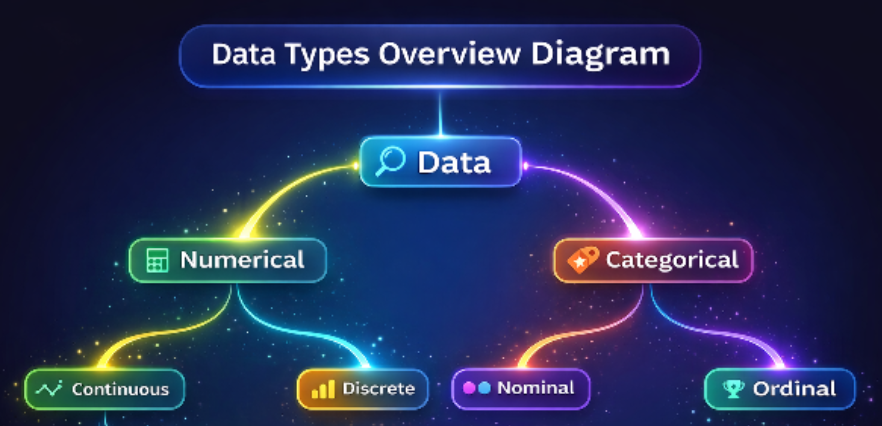
Numerical data includes values that can be measured and calculated. These numbers have real mathematical meanings.
Numerical data is divided into two main types:
1.1 Continuous Data
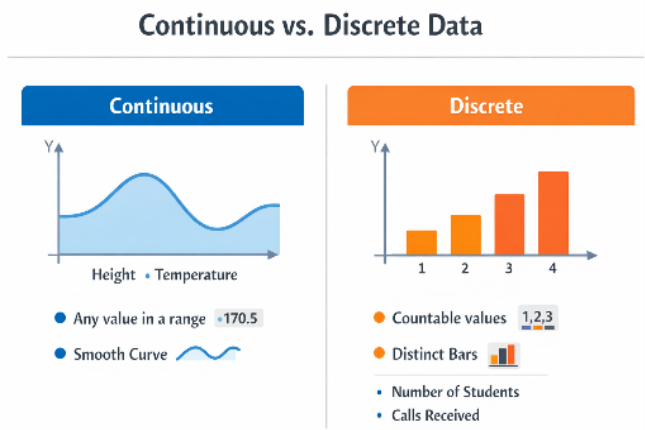
Continuous data can take any value within a range.
Examples:
- Height (170.5 cm)
- Weight (65.8 kg)
- Temperature (36.7°C)
- Salary (₹45,250.75)
Key Characteristics:
- Decimal numbers can be included
- Infinite possible values between two points
Continuous data is commonly used in regression problems.
Example in ML:
A model predicts house prices using total area and neighborhood income.
1.2 Discrete Data
Discrete data contains countable numbers.
Examples:
- Number of students in a class
- Number of products sold
- Number of calls received
These numbers exist as complete entities because 3.7 students cannot exist in reality.
Discrete data is mainly used in counting-based problems.
2️⃣ Categorical Data
Categorical data represents labels or groups.
These categories do not have a mathematical meaning.
You cannot go about taking the mean of “Red” or “Male”.
2.1 Nominal Data
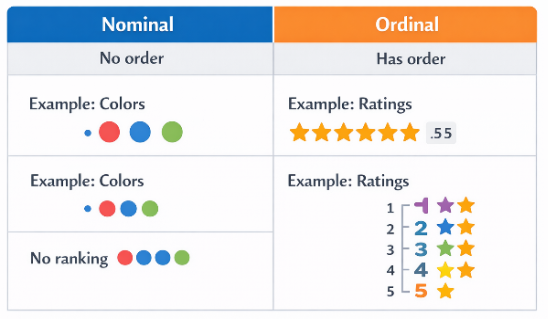
Nominal data consists of categories which do not possess any ordered sequence.
Examples:
- Gender (Male, Female)
- City (Delhi, Mumbai, Chennai)
- Color (Red, Blue, Green)
These categories have no order or ranking.
2.2 Ordinal Data
Ordinal data refers to data that has categories in a meaningful order.
Examples:
- Education Level (High School → Bachelor → Master → Ph.D.)
- Rating (1 Star → 5 Star)
- Satisfaction (Low → Medium → High)
By order, we mean that categories follow a logical sequence.
However, the distance between these levels cannot be measured exactly.
3️⃣ Why Encoding Is Necessary
Most Machine Learning algorithms only understand numbers.
Example:
“Male”, “Female”, “High”, “Low”
Most traditional ML models cannot process raw text directly.
So, we convert categories into numbers using encoding techniques.
4️⃣ Encoding Methods
4.1 Label Encoding
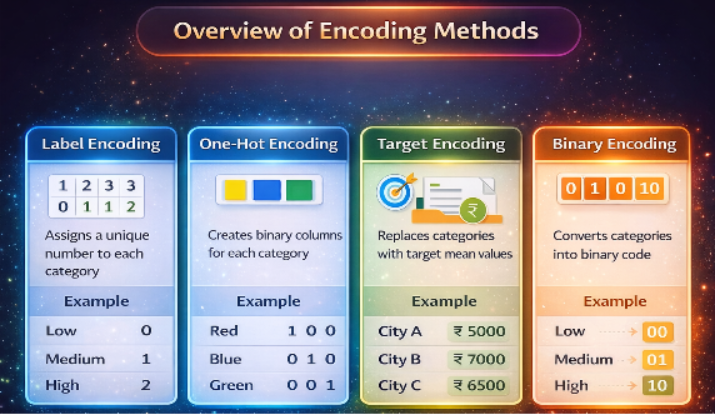
Label Encoding assigns a number to each category.
Example:
- Low → 0
- Medium → 1
- High → 2
Best for:
- Ordinal data (where order matters)
Solution:
If you use it for nominal data, the model may assume a false order.
4.2 One-Hot Encoding
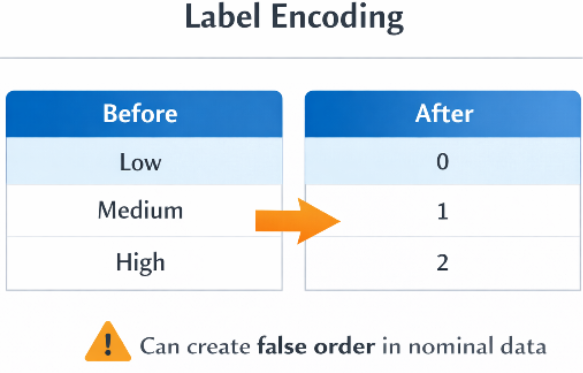
Creates separate columns for each category.
Example:
| Color | Red | Blue | Green |
| Red | 1 | 0 | 0 |
Best for:
- Nominal data
- No order assumption
Downside:
If too many categories → too many columns.
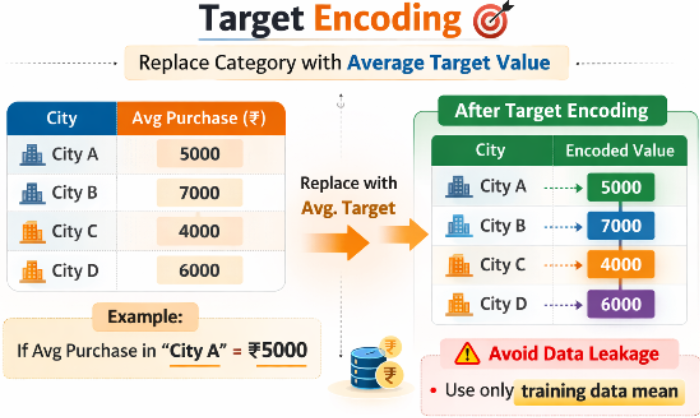
4.3 Target Encoding
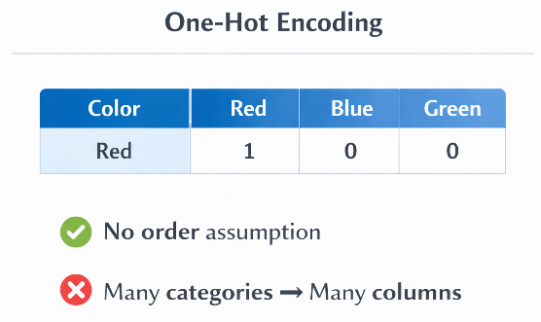
This method substitutes a category with its corresponding average target value.
Example:
If average purchase amount in “City A” is ₹5000
Then City A → 5000
Best for:
- Large datasets
- High-cardinality features
It must be used carefully to avoid data leakage.
4.4 Binary Encoding
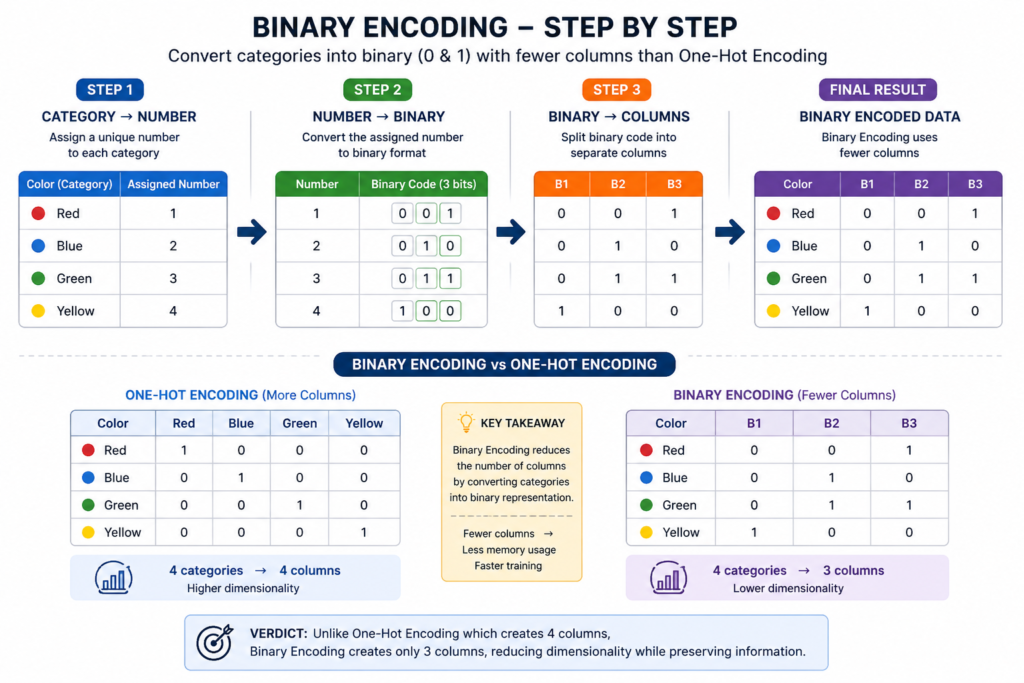
Binary Encoding is a technique used to convert categorical values into binary (0 and 1) formats.
Instead of creating many columns like One-Hot Encoding, it converts categories into numbers first and then transforms those numbers into binary code.
This helps reduce the number of columns.
Example
🔹 Original Data
| Color |
| Red |
| Blue |
| Green |
| Yellow |
🔹 Step 1: Assign Numbers (Label Encoding)
| Color | Assigned Number |
| Red | 1 |
| Blue | 2 |
| Green | 3 |
| Yellow | 4 |
🔹 Step 2: Convert to Binary
| Color | Number | Binary Code |
| Red | 1 | 001 |
| Blue | 2 | 010 |
| Green | 3 | 011 |
| Yellow | 4 | 100 |
🔹 Final Binary Encoded Columns
| Color | B1 | B2 | B3 |
| Red | 0 | 0 | 1 |
| Blue | 0 | 1 | 0 |
| Green | 0 | 1 | 1 |
| Yellow | 1 | 0 | 0 |
Verdict:
Unlike One-Hot Encoding, which creates 4 separate columns (like One-Hot Encoding),
Binary Encoding creates only 3 columns, reducing dimensionality.
5️⃣ Choosing the Right Encoding for Algorithms
“Different algorithms react differently to encoded data.”
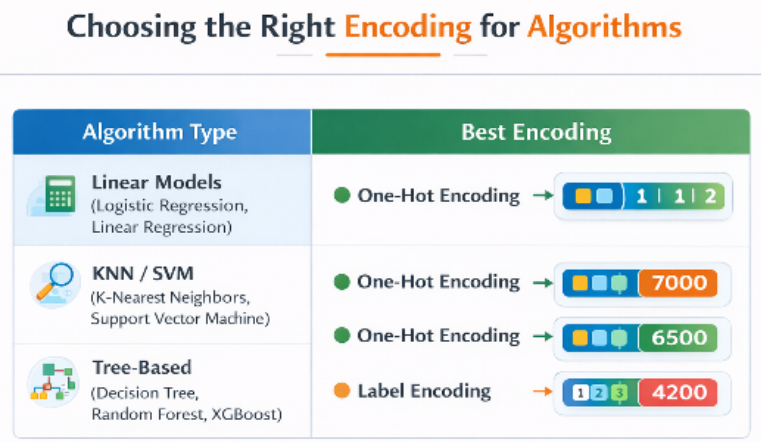
🔹 Linear Models (Logistic Regression, Linear Regression)
- One-Hot Encoding serves as their preferred encoding method
- They are sensitive to numerical magnitude and scale
🔹 Distance-Based Models (KNN, SVM)
- One-Hot Encoding serves as their preferred encoding method
- Their performance is sensitive to scale and dimensionality
🔹 Tree-Based Models (Decision Tree, Random Forest, XGBoost)
- they can process Label Encoding data
- Tree-based models are less sensitive to numerical scaling and artificial ordering
Conclusion
Machine Learning is not just about choosing the right algorithm.
The process begins with data comprehension.
Incorrect handling of categorical data results in poor performance from even the most advanced models.
The complete understanding of data types enables:
- Improved feature development
- More effective data conversion methods
- Higher success rates
- Trustworthy forecasting results
“Before training any model, always ask: What type of data am I working with?”
Machine Learning operates on the principle that better data understanding leads to improved model results.
For deeper context and practical extensions across AI, data science, automation, Python, careers, and industry trends, explore these related articles:
Your Next Step: Turn Learning Into Real Outcomes
Learning creates understanding. Progress comes from applying it with the right guidance. Use the table below to identify your immediate goal, understand what support fits best, and take a clear next step with Craze Neurons.
| What You Need Right Now! | What This Service Helps You Achieve | Starting At | Next Step |
| Upskilling Training | Real-world capability in Data Science, Python, AI, and related fields through hands-on training, live projects, mentorship, and strong conceptual grounding. | ₹2000 | 👉 Start upskilling |
| ATS-Friendly Resume | An ATS-optimized resume that reaches recruiters, built using skill-focused structuring and precise keyword optimization aligned with hiring systems. | ₹599 | 👉 Get an ATS-ready resume |
| Web Development | A responsive, SEO-friendly website designed for visibility and growth, using performance-driven design, clean structure, and search readiness. | ₹5000 | 👉Get Web site support |
| Android Projects | Practical Android development experience gained through real-time projects, guided mentorship, and clear explanations behind technical decisions. | ₹10000 | 👉 Get Android support |
| Digital Marketing | Increased brand visibility and engagement achieved through data-driven SEO, content strategy, social media, and email marketing campaigns. | ₹5000 | 👉 Get digital marketing support |
| Research Writing | Clear, plagiarism-free academic and technical writing delivered through structured, original research with academic integrity. | ₹5000 | 👉 Get research writing support |
❓ Frequently Asked Questions (FAQs) – Craze Neurons Services
0. Not sure which option fits your situation?
A short discussion is often enough to identify the most effective path. We help you clarify scope, effort, and outcomes before you commit.
👉 Talk to Craze Neurons on WhatsApp
1. What is included in the Upskilling Training?
We provide hands-on training in Data Science, Python, AI, and allied fields. This allows us to work with concepts and projects, see practical applications, and explore the deeper understanding of each topic.
2. How does the ATS-Friendly Resume service work?
Our team crafts ATS-optimized resumes that highlight skills, experience, and achievements. This is a service priced at ₹599 and acts as a lens to make the first impression clear, measurable, and effective.
3. What kind of websites can Craze Neurons build?
We build responsive and SEO-friendly websites for businesses, personal portfolios, and e-commerce platforms. This enables us to translate ideas into structure, visibility, and functional design.
4. What are the Android Projects about?
We offer real-time Android projects with guided mentorship. This gives us an opportunity to learn by doing, understand development from multiple angles, and apply knowledge in a controlled, real-world context.
5. What does Digital Marketing service include?
Our service covers SEO, social media campaigns, content marketing, and email strategy, allowing us to look at brand growth quantitatively and qualitatively, understanding what works and why.
6. What type of Research Writing do you provide?
We provide plagiarism-free academic and professional content, including thesis, reports, and papers. This allows us to express ideas, support arguments, and explore knowledge with depth and precision.
7. How can I get started with Craze Neurons services?
We can begin by clicking the WhatsApp link for the service we are interested in. This lets us communicate directly with the team and explore the steps together.
8. Can I use multiple services together?
Yes, we can combine training, resume, web, Android, digital marketing, and research services. This allows us to see synergies, plan strategically, and use resources effectively.
9. Is the training suitable for beginners?
Absolutely. The courses are designed for learners at all levels. They allow us to progress step by step, integrate projects, and build confidence alongside skills.
10. How long does it take to complete a service or course?
Duration depends on the service. Training programs vary by course length. Projects may take a few weeks, while resume, website, or research work can often be completed within a few days. This helps us plan, manage, and achieve outcomes efficiently.
Stay Connected with Us
🌐 Website 📢 Telegram 📸 Instagram 💼 LinkedIn ▶️ YouTube 📲 WhatsApp: +91 83681 95998