Why Fewer Features Can Improve Accuracy
Introduction
Modern data science and machine learning often work with datasets that contain a large number of features. When datasets contain too many features, models become slower, more complex, and sometimes less accurate. Researchers commonly use Dimensionality Reduction to solve this particular issue.
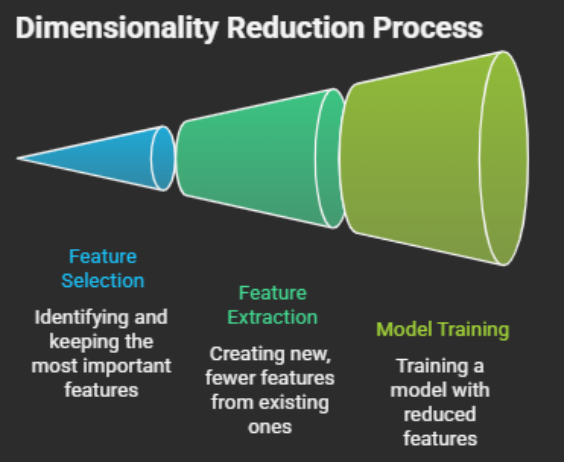
Dimensionality reduction enables researchers to decrease input feature counts while maintaining essential dataset information. The process of data simplification enables models to achieve faster learning times, which results in improved performance.
Curse of Dimensionality
The Curse of Dimensionality describes the issues that arise when datasets contain an excessive number of dimensions.
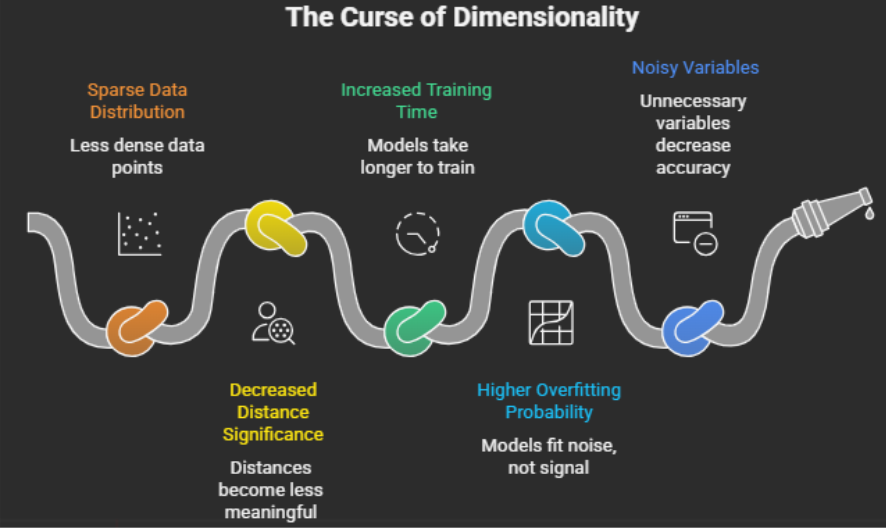
As the number of features increases:
- Data points become more spread out
- Distance between points becomes less meaningful
- Model training takes longer
- Risk of overfitting increases
In many real-world datasets, researchers must work with hundreds of variables. Most of these variables will not provide any beneficial information but instead will create noise that decreases the accuracy of the model.
The practice of dimensionality reduction resolves the issue by eliminating both unnecessary and duplicate features.
Principal Component Analysis (PCA)
Principal Component Analysis (PCA) serves as one of the most common methods for reducing data dimensions.
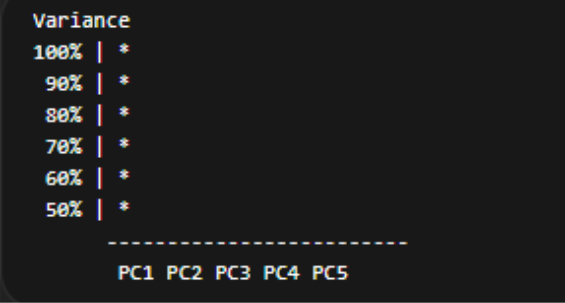
PCA creates Principal Components which serve as new variables to replace original features of the data. These components are designed to capture the maximum variance in the dataset.
Meaning:
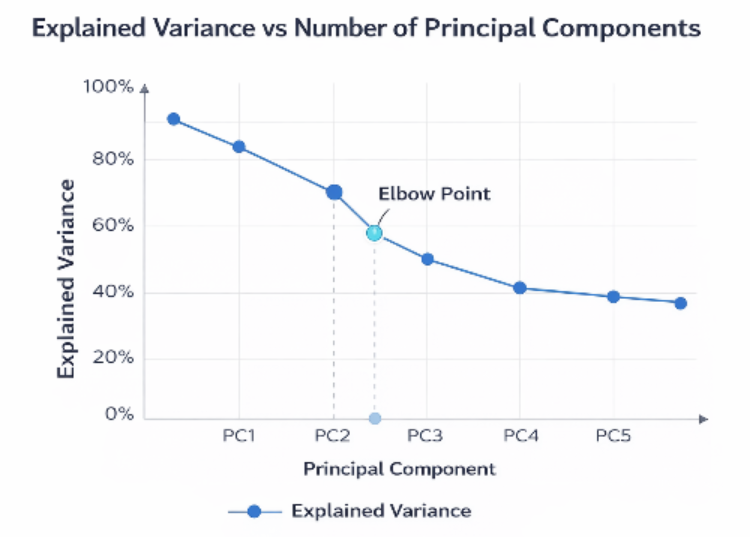
- PC1 explains most variance
- PC2 adds more information
- After some point → improvement becomes small
This point is called Elbow Point.
Explanation:
PCA ranks components based on the amount of variance they capture from the data. A Scree Plot helps visualize this by showing how much variance each component explains. We usually select the number of components where the curve begins to flatten, known as the elbow point.
Main Features of PCA:
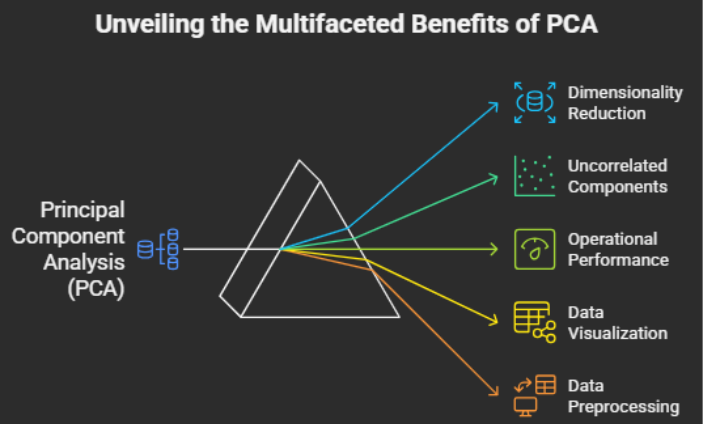
- PCA creates uncorrelated components which result from transforming correlated variables.
- The process decreases data dimensions while maintaining essential data elements.
- The process increases operational performance against lesser computing requirements.
- The technique serves as a common method for both data visualization and data preprocessing activities.
For example, PCA can reduce a dataset with 20 features into 5 principal components.
t-SNE and UMAP
PCA provides useful dimensionality reduction capabilities, but other methods outperform it when it comes to visualizing data.
t-SNE (t-Distributed Stochastic Neighbor Embedding)
Researchers use t-SNE to create 2D and 3D representations of high-dimensional data.
Key features:
- The method maintains the original data structure which exists between close data points.
- The method serves a dual purpose because it enables image recognition and helps visualize clustering results.
- The method enables researchers to discover hidden patterns which exist within intricate datasets.
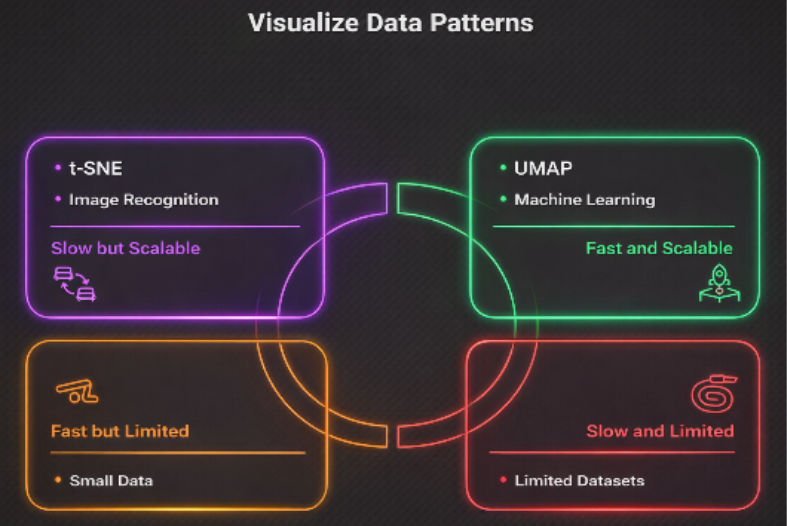
- The method requires substantial computational resources while providing slower performance when handling extensive data sets.
UMAP (Uniform Manifold Approximation and Projection)
The new dimensionality reduction technique UMAP delivers better speed and scalability compared to t-SNE.
The benefits of UMAP include:
- The system provides faster processing times
- The system maintains every aspect of data structure which exists from large to small details
- The system handles extensive data sets efficiently
- The system has become a standard component in current machine learning systems
Data scientists increasingly adopt UMAP because it provides multiple advantages.
“t-SNE and UMAP for Visualization”
t-SNE and UMAP are dimensionality reduction techniques used to visualize high-dimensional data in 2D or 3D space.
The following diagram compares their characteristics.
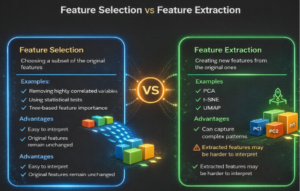
Feature Selection vs Feature Extraction
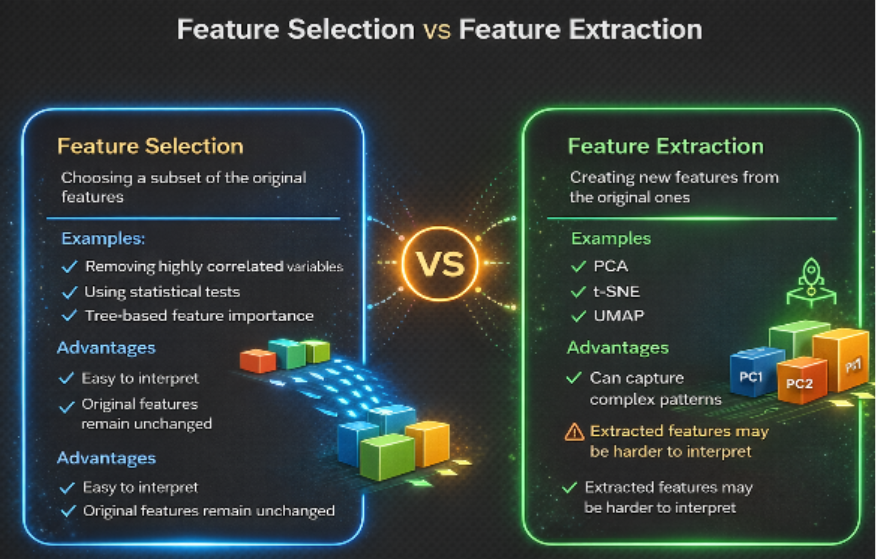
Dimensionality reduction techniques generally fall into two categories:
Feature Selection
Feature selection involves choosing a subset of the original features.
Examples:
- The process involves two steps which begin with the removal of highly correlated variables and continue with the application of statistical tests.
- Tree-based feature importance
Advantages:
- The system provides simple interpretation methods
- The system keeps all original features intact
Feature Extraction
Feature extraction creates new features from the original ones.
Examples:
- PCA
- t-SNE
- UMAP
Advantages:
- The system can discover intricate patterns
- The system frequently achieves better results through dimension reduction
Extracted features may become harder to interpret.
When and Why Dimensionality Reduction Helps
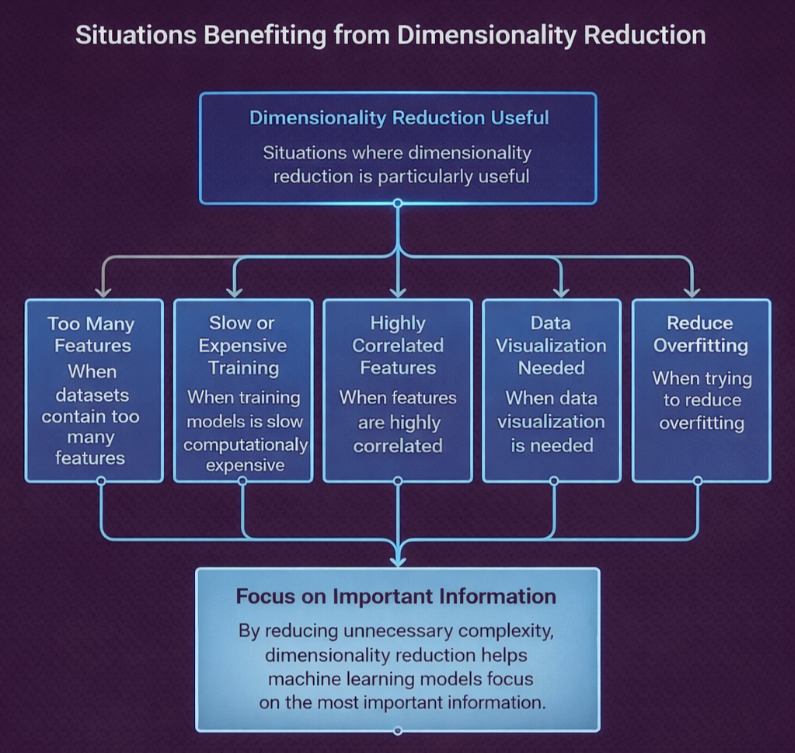
Dimensionality reduction is particularly useful in the following situations:
- When datasets contain too many features
- When training models is slow or computationally expensive
- When features are highly correlated
- When data visualization is needed
- When trying to reduce overfitting
By reducing unnecessary complexity, dimensionality reduction helps machine learning models focus on the most important information.
Conclusion
Dimensionality reduction works as an effective method that reduces dataset complexity while maintaining essential data patterns. Data scientists use PCA, t-SNE, and UMAP as methods to make their data less complex, achieve better model results, and create better visual representations of their data.
The selection of a suitable dimensionality reduction technique depends on three factors which include the dataset and the specific problem and the analysis objectives.
Machine learning models achieve better performance when researchers use reduced sets of intelligent features.
For deeper context and practical extensions across AI, data science, automation, Python, careers, and industry trends, explore these related articles:
Your Next Step: Turn Learning Into Real Outcomes
Learning creates understanding. Progress comes from applying it with the right guidance. Use the table below to identify your immediate goal, understand what support fits best, and take a clear next step with Craze Neurons.
| What You Need Right Now! | What This Service Helps You Achieve | Starting At | Next Step |
| Upskilling Training | Real-world capability in Data Science, Python, AI, and related fields through hands-on training, live projects, mentorship, and strong conceptual grounding. | ₹2000 | 👉 Start upskilling |
| ATS-Friendly Resume | An ATS-optimized resume that reaches recruiters, built using skill-focused structuring and precise keyword optimization aligned with hiring systems. | ₹599 | 👉 Get an ATS-ready resume |
| Web Development | A responsive, SEO-friendly website designed for visibility and growth, using performance-driven design, clean structure, and search readiness. | ₹5000 | 👉Get Web site support |
| Android Projects | Practical Android development experience gained through real-time projects, guided mentorship, and clear explanations behind technical decisions. | ₹10000 | 👉 Get Android support |
| Digital Marketing | Increased brand visibility and engagement achieved through data-driven SEO, content strategy, social media, and email marketing campaigns. | ₹5000 | 👉 Get digital marketing support |
| Research Writing | Clear, plagiarism-free academic and technical writing delivered through structured, original research with academic integrity. | ₹5000 | 👉 Get research writing support |
❓ Frequently Asked Questions (FAQs) – Craze Neurons Services
0. Not sure which option fits your situation?
A short discussion is often enough to identify the most effective path. We help you clarify scope, effort, and outcomes before you commit.
👉 Talk to Craze Neurons on WhatsApp
1. What is included in the Upskilling Training?
We provide hands-on training in Data Science, Python, AI, and allied fields. This allows us to work with concepts and projects, see practical applications, and explore the deeper understanding of each topic.
2. How does the ATS-Friendly Resume service work?
Our team crafts ATS-optimized resumes that highlight skills, experience, and achievements. This is a service priced at ₹599 and acts as a lens to make the first impression clear, measurable, and effective.
3. What kind of websites can Craze Neurons build?
We build responsive and SEO-friendly websites for businesses, personal portfolios, and e-commerce platforms. This enables us to translate ideas into structure, visibility, and functional design.
4. What are the Android Projects about?
We offer real-time Android projects with guided mentorship. This gives us an opportunity to learn by doing, understand development from multiple angles, and apply knowledge in a controlled, real-world context.
5. What does Digital Marketing service include?
Our service covers SEO, social media campaigns, content marketing, and email strategy, allowing us to look at brand growth quantitatively and qualitatively, understanding what works and why.
6. What type of Research Writing do you provide?
We provide plagiarism-free academic and professional content, including thesis, reports, and papers. This allows us to express ideas, support arguments, and explore knowledge with depth and precision.
7. How can I get started with Craze Neurons services?
We can begin by clicking the WhatsApp link for the service we are interested in. This lets us communicate directly with the team and explore the steps together.
8. Can I use multiple services together?
Yes, we can combine training, resume, web, Android, digital marketing, and research services. This allows us to see synergies, plan strategically, and use resources effectively.
9. Is the training suitable for beginners?
Absolutely. The courses are designed for learners at all levels. They allow us to progress step by step, integrate projects, and build confidence alongside skills.
10. How long does it take to complete a service or course?
Duration depends on the service. Training programs vary by course length. Projects may take a few weeks, while resume, website, or research work can often be completed within a few days. This helps us plan, manage, and achieve outcomes efficiently.
Stay Connected with Us
🌐 Website 📢 Telegram 📸 Instagram 💼 LinkedIn ▶️ YouTube 📲 WhatsApp: +91 83681 95998