Introduction
Artificial Intelligence is transforming the way machines interact with the world.
At the core of many AI systems are intelligent agents, which allow machines to observe their environment, make decisions, and perform actions to achieve specific goals.
Intelligent agents act as the fundamental building blocks of AI systems and enable machines to demonstrate intelligent behavior.
In this blog, we will explore what intelligent agents are and understand the different types of agents used in AI.
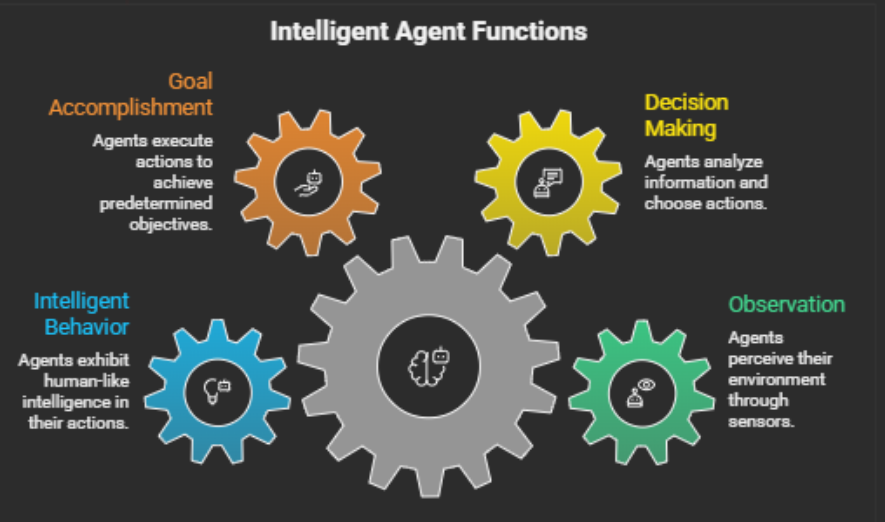
What is an Intelligent Agent?
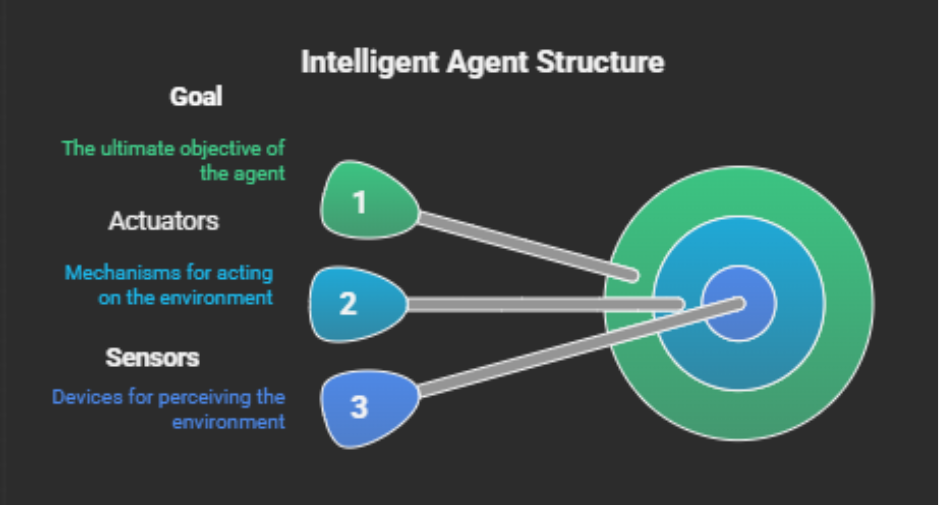
An intelligent agent is a system that perceives its environment through sensors and acts upon that environment using actuators to achieve its goals.
Key Components of an Intelligent Agent
| Component | Description |
| Sensors | Collect information from the environment |
| Agent | Processes information and decides what action to take |
| Actuators | Execute the chosen action in the environment |
Example
A self-driving car serves as an excellent demonstration of an intelligent agent.
- Sensors → The system uses cameras and radar, and LiDAR technology.
- Processing → An AI system performs road condition analysis.
- Actuators → The system controls steering and braking and acceleration.
The agent operates its environment monitoring system to select driving actions which maximize its safe driving ability.
Types of Intelligent Agents
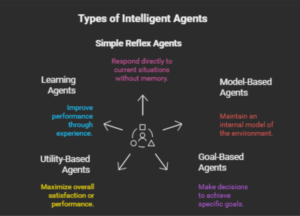
Various types of agents are identified by AI researchers on the basis of how they make decisions.
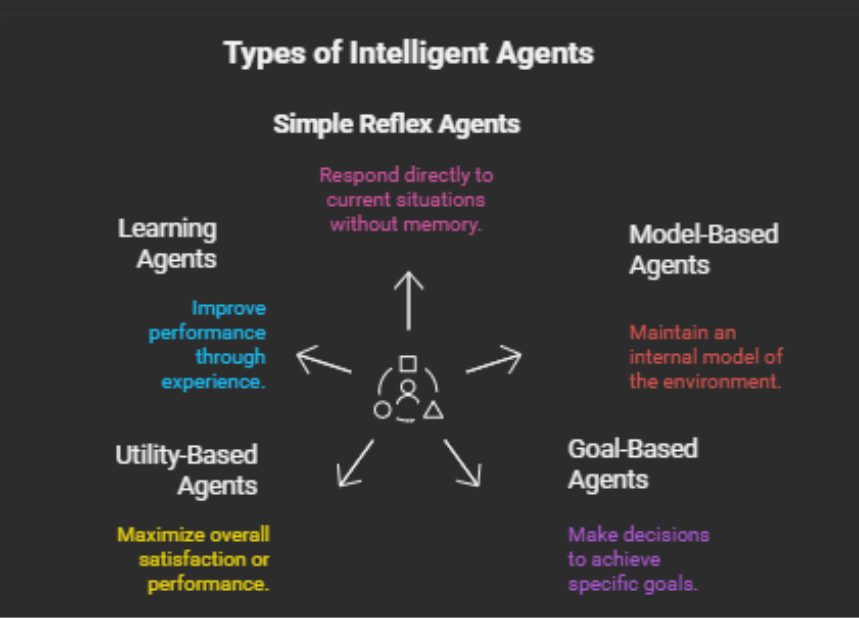
Here is the information.
1. Simple Reflex Agents
The simplest form of intelligent agents exists as simple reflex agents.
The agents use condition–action rules to execute their tasks which enable them to react to present conditions without investigating their previous experiences.
How They Work
IF condition occurs → perform action
Example
A thermostat:
IF temperature < 20°C → Turn heater ON
IF temperature ≥ 20°C → Turn heater OFF
Characteristics
- The system operates using the present percept only.
- The system has no ability to remember previous conditions.
- The system makes decisions at high speed.
- The system possesses only basic thinking capabilities.
Limitation
- The system becomes unworkable when the environment has incomplete visibility.
2. Model-Based Reflex Agents
Model-based agents are more advanced than simple reflex agents because they maintain an internal model of the environment.
The system enables them to monitor world transformations that occur throughout different time periods.
How They Work
The agent maintains its internal state which updates through three different processes:
- Current perception
- Previous state
- Knowledge of how the environment works
Example
A robot vacuum cleaner:
- Remembers which areas are already cleaned
- Avoids obstacles
- Adjusts movement accordingly
Advantages
- The system can operate in environments where not all information is visible to it
- The system uses its stored information to enhance its decision-making capabilities
3. Goal-Based Agents
Goal-based agents make their decisions through a process which helps them reach their particular target.
The agents evaluate potential outcomes from different actions before they make their final decision instead of responding through automatic triggers.
How They Work
The agent evaluates all possible actions to determine which option will help it achieve its goal.
Example
A navigation system:
The system evaluates multiple routes and chooses the best one.
Key Features
- The system uses search and planning methods for its operations.
- The system provides users with enhanced options for making decisions.
- The system enables users to assess various tactical approaches which they can implement.
4. Utility-Based Agents
Utility-based agents take a more advanced approach to decision-making compared to standard methods.
They work to achieve their goal, but their focus is on achieving the highest possible satisfaction level through their efforts.
How They Work
The agent selects its action based on which outcome generates the highest utility value assigned to each possible result.
Example
An AI stock trading system:
Goal → Make profit
The system also includes two additional factors:
- Risk
- Market volatility
- Expected return
The agent selects the action that provides the maximum expected value.
Advantages
- The system can solve difficult decision problems.
- The system maintains equilibrium between different decision factors.
5. Learning Agents
The advanced form of intelligent agents is called learning agents.
Their ability to learn from experience enables them to develop better performance throughout their lifetime.
Key Components of a Learning Agent
| Component | Function |
| Learning Element | Improves performance using experience |
| Performance Element | Selects actions |
| Critic | Evaluates agent performance |
| Problem Generator | Suggests exploratory actions |
Example
A recommendation system such as movie recommendations:
- Learns user preferences
- Updates suggestions based on behavior
Advantages
- System adapts to new situations
- System accuracy improves throughout its operational period
- Systems can operate successfully in complicated environments
Comparison of Agent Types
| Agent Type | Memory | Goal-Oriented | Learning Ability |
| Simple Reflex Agent | No | No | No |
| Model-Based Agent | Yes | No | No |
| Goal-Based Agent | Yes | Yes | No |
| Utility-Based Agent | Yes | Yes | No |
| Learning Agent | Yes | Yes | Yes |
Why Intelligent Agents Are Important in AI
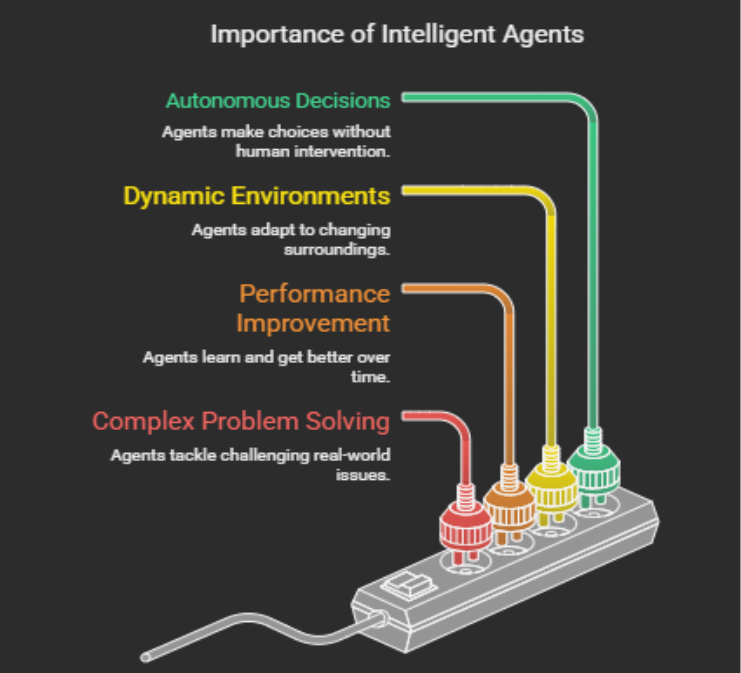
Intelligent agents are essential because they enable machines to:
- Make autonomous decisions
- Interact with dynamic environments
- Improve performance over time
- Solve complex real-world problems
Their uses:
- Robotics
- Autonomous Driving
- Virtual Personal Assistants
- Healthcare Diagnosis
- Recommendation Engines
Conclusion
The use of intelligent agents as fundamental components establishes the basis for contemporary artificial intelligence systems. The various agent types, which range from basic reflex agents that execute fundamental rules to complex learning agents that gain knowledge through their experiences, contribute essential functions to the development of intelligent machines.
The ongoing development of artificial intelligence technology will lead to the creation of more advanced intelligent agents, which will enable systems to make better choices and establish improved interactions with their surrounding environment.
The study of these agent classifications enables us to comprehend the methods through which AI systems perceive their surroundings and make choices while they develop new abilities.
For deeper context and practical extensions across AI, data science, automation, Python, careers, and industry trends, explore these related articles:
Your Next Step: Turn Learning Into Real Outcomes
Learning creates understanding. Progress comes from applying it with the right guidance. Use the table below to identify your immediate goal, understand what support fits best, and take a clear next step with Craze Neurons.
| What You Need Right Now! | What This Service Helps You Achieve | Starting At | Next Step |
| Upskilling Training | Real-world capability in Data Science, Python, AI, and related fields through hands-on training, live projects, mentorship, and strong conceptual grounding. | ₹2000 | 👉 Start upskilling |
| ATS-Friendly Resume | An ATS-optimized resume that reaches recruiters, built using skill-focused structuring and precise keyword optimization aligned with hiring systems. | ₹599 | 👉 Get an ATS-ready resume |
| Web Development | A responsive, SEO-friendly website designed for visibility and growth, using performance-driven design, clean structure, and search readiness. | ₹5000 | 👉Get Web site support |
| Android Projects | Practical Android development experience gained through real-time projects, guided mentorship, and clear explanations behind technical decisions. | ₹10000 | 👉 Get Android support |
| Digital Marketing | Increased brand visibility and engagement achieved through data-driven SEO, content strategy, social media, and email marketing campaigns. | ₹5000 | 👉 Get digital marketing support |
| Research Writing | Clear, plagiarism-free academic and technical writing delivered through structured, original research with academic integrity. | ₹5000 | 👉 Get research writing support |
❓ Frequently Asked Questions (FAQs) – Craze Neurons Services
0. Not sure which option fits your situation?
A short discussion is often enough to identify the most effective path. We help you clarify scope, effort, and outcomes before you commit.
👉 Talk to Craze Neurons on WhatsApp
1. What is included in the Upskilling Training?
We provide hands-on training in Data Science, Python, AI, and allied fields. This allows us to work with concepts and projects, see practical applications, and explore the deeper understanding of each topic.
2. How does the ATS-Friendly Resume service work?
Our team crafts ATS-optimized resumes that highlight skills, experience, and achievements. This is a service priced at ₹599 and acts as a lens to make the first impression clear, measurable, and effective.
3. What kind of websites can Craze Neurons build?
We build responsive and SEO-friendly websites for businesses, personal portfolios, and e-commerce platforms. This enables us to translate ideas into structure, visibility, and functional design.
4. What are the Android Projects about?
We offer real-time Android projects with guided mentorship. This gives us an opportunity to learn by doing, understand development from multiple angles, and apply knowledge in a controlled, real-world context.
5. What does Digital Marketing service include?
Our service covers SEO, social media campaigns, content marketing, and email strategy, allowing us to look at brand growth quantitatively and qualitatively, understanding what works and why.
6. What type of Research Writing do you provide?
We provide plagiarism-free academic and professional content, including thesis, reports, and papers. This allows us to express ideas, support arguments, and explore knowledge with depth and precision.
7. How can I get started with Craze Neurons services?
We can begin by clicking the WhatsApp link for the service we are interested in. This lets us communicate directly with the team and explore the steps together.
8. Can I use multiple services together?
Yes, we can combine training, resume, web, Android, digital marketing, and research services. This allows us to see synergies, plan strategically, and use resources effectively.
9. Is the training suitable for beginners?
Absolutely. The courses are designed for learners at all levels. They allow us to progress step by step, integrate projects, and build confidence alongside skills.
10. How long does it take to complete a service or course?
Duration depends on the service. Training programs vary by course length. Projects may take a few weeks, while resume, website, or research work can often be completed within a few days. This helps us plan, manage, and achieve outcomes efficiently.
Stay Connected with Us
🌐 Website 📢 Telegram 📸 Instagram 💼 LinkedIn ▶️ YouTube 📲 WhatsApp: +91 83681 95998